The Power of the Negative

As leaders, there are times we have to make difficult decisions on how to address the mistakes, weaknesses, or shortcomings of others. After taking time to pray and think through the situation, we still find ourselves struggling with how to approach the other person in just the right way. We want them to know how important they are; however, their actions are hurting others and must be dealt with.

The Power of the Negative” is a post which Dr. Thom Rainer calls attention to our need to have a healthy balance when using negative reinforcement.

Rainer writes:

I often turn to Brad Waggoner for leadership advice and wisdom. He serves as executive vice president of LifeWay and, previously, as dean of a graduate school of leadership. He provides me a gentle reminder from time to time on, to use his words, “the power of the negative.”

Indeed I often have to remind myself of this leadership principle.

Understanding the Principle

The principle is simple but profound: Negative reinforcement has 20 times or more power than positive reinforcement.  At first glance, a leader may conclude that speaking and leading negatively is the best path since it is so powerful. To the contrary, unless used wisely, negative words and leadership can demoralize, demotivate, and destroy because of its very power.

While there is a place for negative leadership, it must be used with the greatest of care and discernment.

Examples for All of Us

We all experience the power of the negative, either as givers or recipients. See if you can identify with any of these examples:

  • You speak or preach somewhere and you get twenty compliments and one criticism. Upon which one do you dwell?
  • A husband in anger tells his wife that he is tired of her. Though he has given her over a dozen compliments that week, which one does she remember?
  • A child receives accolades for her good grades that semester. But the dad, upon discovering the child has her first failing grade, tells her “you won’t amount to anything in life at the pace you are going.” Which of the father’s words stick with the child for years if not a lifetime?
  • One coworker points out problems in another coworker’s area. Though the praises have been equal to the criticisms, which have the greatest power?
  • A CEO who has provided mostly steady leadership for a few years has an anger meltdown in front of his direct reports. What facet of his leadership is remembered the most?

A Time to Tear Down, A Time to Build Up

The writer of Ecclesiastes tells us clearly that there are times to be negative and times to be positive (3:3). Indeed there are times for a prophetic voice, a corrective voice, and an admonishing voice. The problem is that the writer of Ecclesiastes does not give us specific instruction on timing and frequency.

Many of us are tempted to exercise the power of the negative too frequently. When we are negative about some other person and event, we are able to look away from ourselves and our own weaknesses and failures. It’s easier to the point the finger of accusation at someone other than ourselves.

Further the power of the negative can be tempting because we often get attention when we do so. I can point to one example clearly on this blog. The article that has received the most views was a negative article I wrote on Jerry Sandusky and the Penn State child sex abuse scandal. I am convinced and convicted that the article was appropriate and timely. But I must ever keep in mind the power that negativity has.

The Power of the Negative and Discernment

The Apostle Paul said these words to a church 2,000 years ago, and they still apply to us today: “Therefore encourage one another and build each other up as you are already doing” (1 Thessalonians 5:11, HCSB). There are indeed times when a prophetic or negative word is in order. There are moments in any leader’s lives, whether a parent, pastor, or president, that the power of the negative should be exercised.

But it should be exercised with wisdom and discernment.

It would seem that the preponderance of our leadership should be one of building up and encouraging. Such leadership can change a family for the good. It can change an organization for the good.

And it might just change the world for good.
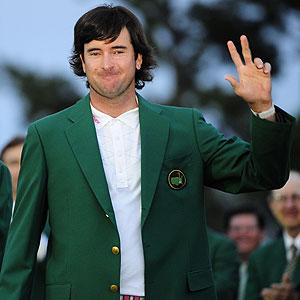
Way To Go Bubba!

In recent years we have heard a lot of athletes talking about their faith in Christ. Last week after winning the Masters golf tournament Bubba Watson gave the following interview with the Billy Graham Evangelistic Association:

Bubba Watson, first-time winner of a Masters Tournament who earned his green jacket on Easter Sunday, recently spoke about tweeting for God, the PGA Bible study he took part in and his newly adopted son.

Watson, 33, spoke with the Billy Graham Evangelistic Association after winning the 2012 Masters Tournament on Sunday. The golfer who tearfully thanked his “Lord and Saviour Jesus Christ” after the big win, said he utilises his Twitter account to spread his Christian faith.

Watson describes himself on his Twitter page as “Christian. Husband. Daddy. Pro Golfer”. The Christian golfer said he has lost at least 100 followers for tweeting biblical messages.

When Watson receives negative backlash for his biblical tweets, he responds with messages like “I will pray for u and ur family.” The golfer also quoted one of his favorite Christian rappers, Lecrae, saying he would like his followers to see God through him.

“Lecrae said it the best,” Watson told the Billy Graham Evangelistic Association. “He doesn’t want to be a celebrity. He doesn’t want to be a superstar. He just wants to be the middle man for you to see God through him.”

Watson maintained his Christian principles during the golf tournament by engaging in an hour-long Bible study with fellow golfers each week. He described the importance of being able to connect with both God and his peers.

“For me it’s a way to get back connected with the Bible and with God and Jesus. Now you know other people you can talk to, ask questions to, tell them what you’re thinking, tell them what’s going on in your life,” Watson said. “Getting more in the Word and realising that golf is just an avenue for Jesus to use me to reach as many people as I can.”

Watson, who recently adopted a one-month-old baby boy named Caleb with his former WNBA playing wife Angie Ball, also described his first church experience. According to Watson, twin girls from his neighbourhood convinced him to attend.

“The girls asked me to go to church,” Watson said. “And after a few times going I realised this is what I wanted to do. This is truth here. And I gave myself to the Lord.”

After he began dating Ball, the couple decided to live for Christ. Watson decided to get baptised with his wife in 2004 as a student at the University of Georgia.

“We wanted to be Christ followers,” Watson said. “We wanted to do the right thing. We started turning to the Lord for our decisions.”

The professional golfer, who said he has never taken a lesson, said he was grateful for the people around him and the opportunity to live his life for Christ.

“I’ve really got a good team around me trying to help me succeed,” Watson said. “Not just in golf, but off the golf course, to be a light for Jesus.”

Here Comes the Groom!

I have performed many weddings over my eighteen years in ministry. Just before the wedding starts I always tell the groom, “Be sure to watch as the doors open and you see your bride for the first time. It will be a memory you will never forget.” They usually nod out of respect not understanding exactly why I gave them that simple piece of advice. But then it happens, the doors open and standing there before them is their bride. The grooms eyes widen, his smile grows, and then a mental picture is taken that he will always remember. The long-awaited day of receiving his bride has arrived, and now they get to spend the rest of their lives together.

Jason Johnson writes in his post, “Easter and the Great Wedding to Come,” some of the truths from Scripture about the coming of The Groom for His bride—the church. One day Jesus will return for His bride, and their will be a great wedding on that day. It is a future day which should bring great anticipation, expectation, and preparation.

Johnson writes:

Throughout Scripture the marriage relationship is used as a picture of God’s relationship with his people. The bride and groom imagery highlights not only the covenantal love of God for his people but also their position within that relationship as the beneficiaries of his redemptive pursuit. A common theme woven within the thread of Scripture, from the Old to the New Testament, is God’s unwavering, unalterable, unceasing pursuit of his people into the consecrating and cleansing relationship of eternal marriage.

This is why the hallmark of all God’s grievances against his people is spiritual adultery, a heinous infidelity on the part of his people as they pursue lesser lovers and stray outside the conditions of the covenantal relationship (Jeremiah 13:27; Mark 8:38). God is a jealous God (Exodus 20:3-5; Deuteronomy 6:14-15), not because he lacks in companionship but because he longs for the exclusive affections of his people, as a groom does for his bride.

Jesus adopts the imagery of bride and groom as it pertains to his present application of the New Covenant and his future consummation of salvation through the great, eternal marriage with the church. In the Parable of the Ten Virgins (Matthew 25:1-13), Jesus allegorizes himself as the bridegroom and urges his disciples to stay alert, because they do not know the day or the hour he will return and take them to the eternal wedding celebration, i.e., the kingdom. He again refers to himself as the bridegroom while instructing his disciples on the proper purpose and function of fasting (Mark 2:18-20). As the bridegroom he will return to take his bride home, yet in the meantime, while he is present with them, fasting and longing for his return is not necessary.

Anticipation, Expectation, Preparation

The central focus of the wedding imagery in Scripture is anticipation, expectation, and preparation. It closely mirrors the traditional order of a first-century wedding, which involved a father arranging a bride for his son and paying the predetermined “bride price” on her behalf. The son would then return to his father’s house to make arrangements while the bride consecrated herself in eager anticipation for his final return for her. The terms of the relationship were sealed with ceremonial sharing of a glass of wine before the two parted ways and entered a time of anticipation and preparation leading up to the final wedding feast.

In strikingly similar fashion, God the Father has sent Jesus the Son to secure his bride, the church. The terms of the covenantal relationship between God and his people have been outlined in the gospel, and a great price has been paid by the Father to secure the relationship, namely, through the sacrifice of the Son on the Cross (1 Corinthians 6:20). The night before he would go to the Cross, Jesus shared a cup with his disciples as a means of symbolically sealing their new covenantal relationship. He instructed them to partake of this cup after his departure in remembrance of the price he paid for them and in anticipation of his future and final return for them.

Upon departure he will go to his Father’s house to prepare a place but will return one day to bring his bride home with him forever (John 14:2-3). The day and the hour of his return are unknown by all but the Father (Matthew 24:26). The bride of Christ, the church, eagerly waits and makes herself ready, setting herself apart for him and him alone, purifying herself for the day when he will return for her forever (1 Peter 1:13-16). He will come, and when he does the eternal wedding feast will commence (Revelation 19:7-8).

The recognition of the death and resurrection of Jesus at Easter is not an isolated act of God but a pinnacle point in the ongoing bride-groom narrative running throughout the current of Scripture. It’s the celebration of God acquiring a bride for his Son through the ultimate price of death paid on the Cross. It’s the height of God’s radical, redemptive pursuit of a sinful and broken people to secure them as his beautifully treasured Bride.

Wonder of the Gospel

Easter is the joyous celebration of the wonder of the gospel—that God has gone to great lengths to secure us for his Son. We are forever bound to Jesus by his death that purchased us and his resurrection that secured us into a future inheritance that is “imperishable, undefiled, and unfading, kept in heaven for you, who by God’s power are being guarded through faith for a salvation ready to be revealed in the last time” (1 Peter 1:4-5).

So we live in this present day as those who are consecrated to our future Groom—holy, set apart, uniquely and distinctively his. We live today with an eager sense of anticipation for the return of our Groom on a tomorrow yet to come. We live today as those who are valued not by the standards of this world but by the infinite price our Savior was willing to pay for us on the Cross. We are invaluably his, and he is ours.

We anticipate, we expect, and we prepare. Our Groom is coming back to take us home.

“The Comfort of a Cold Wet Nose” by Barbara Baumgardner

I hadn’t even wanted the dog in the first place! My husband insisted that I get him to replace the dog that had died recently. Soon, he was “my dog”, a friend and a faithful companion; not asking for anymore than I was willing to give—a daily meal, a kind word, a warm bed.

But not my bed! No dogs allowed on my bed.

The night after my husband died, I lay there, staring into the darkness, my pillow soppy wet with the unending flow of tears. The bed seemed so big all by myself and I was wondering how long it takes for a good case of loneliness to heal when I first felt it move. It was cold and clammy and creeping at a very slow pace into my open hand outside the covers. The solidified jelly like mass was followed by prickly hairs and just before I screamed, a muffled but familiar whine came from the creature that was forcing its cold, wet nose into my trembling hand.

“Oh, Shawn! What are you doing on my bed?” I threw my arms around his thick hairy neck and hugged and hugged.

In the days and months to follow, I came to realize that this dog I hadn’t wanted was a gift of love from God. He was a warm fuzzy on my bed every night; a companion always willing, wagging, and available to go out for a walk when I needed to get out of the house. Twice, he snapped at me as I wailed loudly and out of control, as if to reprimand me to be strong and of good courage.

Shawn taught me all about love and acceptance and forgiveness. That crazy dog loves me just as I am. And so I have learned to be a warm fuzzy to those around me who are hurting and to approach them gently, loving them just as they are. Like a dog curled up by the warm fire, I just want to be there in case I am needed. I thank God for providing me a friend when I felt alone, and for the comfort of a cold, wet nose.

The Rescue!

Throughout Easter weekend I read several posts that greatly blessed my heart. “How the Resurrection Undoes Our Need to Be Proven Right” by Russell Moore was one of my favorites.

Dr. Moore writes:

As Jesus drowned in his own blood, the spectators yelled words quite similar to those of Satan in the wilderness: “Let the Christ, the King of Israel, come down now from the cross that we may see and believe” (Mk. 15:32).

But Jesus didn’t jump down. He didn’t ascend to the skies. He just writhed there.

The bloated corpse of Jesus hit the ground as he was pulled off that stake, spattering warm blood and water on the faces of the crowd.

That night, the religious leaders probably read Deuteronomy 21 to their families, warning them about the curse of God on those who are “hanged on a tree.” Fathers probably told their sons, “Watch out that you don’t ever wind up like him.”

Those Roman soldiers probably went home and washed the blood of Jesus from under their fingernails and played with their children in front of the fire before dozing off. This was just one more insurrectionist they had pulled off a cross, one in a line of them dotting the roadside. And this one (what was his name? Joshua?) was just decaying meat now, no threat to the Empire at all.

The corpse of Jesus just lay there in the silence of that cave. By all appearances it had been tested and tried, and found wanting.

If you had been there to pull open his bruised eyelids, matted there together with mottled blood, you would have looked into blank holes. If you had lifted his arm, you would have felt no resistance. You would have heard only the thud as it hit the table when you let it go. You might have walked away from that morbid scene muttering to yourself, “The wages of sin is death.”

But sometime before dawn on Sunday morning, a spike-torn hand twitched. A blood-crusted eyelid opened. The breath of God came blowing down into that cave, and a new creation flashed into reality.

God was not simply delivering Jesus (and with him all of us) from death. He was also vindicating him (and with him all of us). By resurrecting Jesus from the dead, God was affirming what he had said over the Jordan waters. He was declaring Jesus “to be the Son of God in power” (Rom. 1:4).

This was done, the Bible says, by “the Spirit of holiness.” This is the same Spirit who rested on Jesus at his baptism “like a dove” (Matt. 3:16). I wonder if, as the dovish Spirit alighted on him in the water and in the tomb, Jesus might have thought of the words of the Psalm the Devil would quote in the wilderness: “He will cover you with his pinions, and under his wings you will find refuge” (Ps. 91:4).

With that kind of rescue, who needs to be proven right in any other way?

Note: The following post is an excerpt from Tempted and Tried: Temptation and the Triumph of Christ(Wheaton, IL: Crossway, 2011).