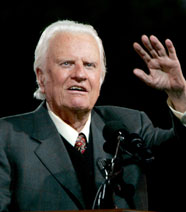
“A Fresh Vision for America” by Billy Graham

From the Desk of Billy Graham:

All of us care a great deal about our country. The intensity of opinions and feelings during the long political campaign showed the depth of that concern.

Now with the votes counted, it is important to remember that whether we are personally pleased with the outcome or not, God wants us to pray for those chosen to be our leaders—at the national, state, and local levels. The Bible urges us to do so with both respect and thanksgiving (see 1 Peter 2:17; 1 Timothy 2:1–3).

We must also remember that no election will ever solve America’s most basic problems. That is because the trouble, at its root, is in the human heart, and the only path to true restoration—for a person or for a nation—is through repentance. The Bible says, “Repent therefore, and turn back, that your sins may be blotted out, that times of refreshing may come from the presence of the Lord” (Acts 3:19–20, ESV).

Only the Gospel, God’s Good News, has the power to change lives, heal hearts, and restore a nation.

I want that to happen in America, and I know you want that as well. I turned 94 on the day after the election. Although my age and health have limited me physically in recent years, I plan to spend the next 12 months, if God permits, doing all that I am able to do in helping to carry out a fresh vision God has given us—a vision to bring the Gospel of Jesus Christ to every possible place in America by the time of my 95th birthday. It’s called My Hope, and I pray that you will partner with us.

In the days of the Prophet Jeremiah, God commanded His people to “seek the peace and prosperity” of the land where He had placed them and to “pray to the Lord for it” (Jeremiah 29:7, NIV). I ask you to join me in committing the next 52 weeks to faithful, even fervent, prayer for this land in which we live. You can start by making a list of people you know personally who need Jesus Christ and then begin praying regularly for them, individually by name.

Pray also for your neighborhood and your city, asking God to bring men, women, teens, and children—people from your own community—to Himself during the next 12 months. And pray along with me for the nation, asking God for mercy on America and for a great spiritual awakening.

My son Franklin is spearheading this vision and outreach, working in partnership with thousands of churches across every state in the country (ask your pastor if your church plans to take part). Franklin will be sending you more details on how this will work through the coming months and how you can participate.

At the climax of My Hope one year from now, if God enables me, I want to call the entire nation to repentance and lasting hope in Jesus Christ. The message I give will be presented in a fresh format, different from preaching at a Crusade, but the same Gospel. I believe we will see God work in a mighty way.

It is my passionate, heartfelt desire to see God change hearts and lives in every community in America, and I pray He will stir the same desire in you.

Will you join Franklin and me in this bold venture?

May God bless you,

Billy Graham              

 Source: Billy Graham Evangelistic Association

Everyone Deserves a Chance

Garrett Kell’s post “The Great Tragedy of the 2012 Election” gives a wonderful perspective of the church’s responsibility to promote life. Please take time to prayerfully read this article and then pass it on to your friends. Regardless of the policies on abortion that come from the White House, Christians should make every effort to inform others of God’s love for everyone ever conceived.

Kell writes:

A great tragedy unfolded less than one week ago on Tuesday, November 6, 2012.

The tragedy was not found in the celebrations of elected officials or the concessions of defeat. It was not colored red or blue, and it wasn’t wrapped up in meaningless campaign promises.

The tragedy of the 2012 election is that in this land of the free and home of the brave, many people were not allowed to vote. Their voices were silenced. Their votes were not cast. Their opinions not expressed. Why?

Because they were dead.

The great tragedy of the 2012 election is that roughly 33 million would-be voters had been murdered. From 1973 to 1994, roughly 35 million babies were aborted. That’s roughly 35 million 18- to 39-year-olds who could not vote from the grave.

This is an unspeakable tragedy.

They did not have the chance to learn what makes our nation so great. They did not have the chance to watch the results roll in with their friends and family. They did not have the chance to rest their heads on a pillow in the land of the free.

But this tragedy is not over.

In 2016, roughly 5 million more voices will be unheard. Why? Because more than 3,500 babies will be killed today. And each day leading up to Tuesday, November 8, 2016. In the three minutes it takes you to read this article, seven babies will have been aborted in the United States of America. Their voices silenced. Their freedom robbed. Their bravery unknown.

Close to Home

This is a tragedy that hits close to home. When I was 19, I chose to end the life of my first child through an abortion. My friend and I were in a scary place, we didn’t plan to get married, and we had nowhere else to go. So we opted to end the life of our child.

That child would be 16 today. They’d be excited about driving a car and, in just a couple of years, they’d be excited about voting. But they won’t be doing any of that. We won’t be sitting down together as I explain how to think about policies and the candidates who represent them. I won’t be able to tell them about freedom and justice for all. I took that freedom away with my injustice.

I cannot undo what I’ve done in the past. None of us can. Only Jesus, who shed his blood for sinners like me, can heal those wounds. Jesus gives us great hope in the midst of this tragedy, and all the other tragedies we face in this life.

Refuge in Jesus

If you have committed an abortion, I want you to know there is a refuge in Jesus. He will heal your wounds. There is no sin so great that he cannot forgive and no sin so small that does not need to be forgiven. If you will confess your sins and turn to him in faith, he will wash away all your guilt and all your shame. Come to Christ.

If you support abortion, I encourage you to spend time in prayer and ask God to show you if abortion pleases him or not. Ask a Christian to help you learn what God’s Word says. I know you already have deeply rooted ideas. I did too. But I encourage you to take the time to read what God says about life and who has the right to give and take it away. I encourage you to start with Psalm 139.

Difficult Choice

If you are a Christian, be patient with those who view things differently. But also speak truth in love to those who are in need. Find ways to help those who are struggling through unplanned pregnancies. Investigate options for adoption and invest in the lives of those who are facing difficult choices.

I have on my wall a picture of a 3-year-old boy in cowboy boots. He nearly wasn’t with us today because his mother was in a difficult place. She was unmarried, pregnant, and scared. But my wife met with her, prayed with her, and took her to a Christian doctor who showed her the baby in her womb through a sonogram. That young mother had the courage to keep her child.

That young boy’s smile reminds me that God can save children, one at a time. He does this by using his people to come alongside the struggling to lovingly show them the Christ who can walk them through any terrifying situation—even an unplanned pregnancy.

I believe the only hope to turn the trend of this tragedy is for people to turn their hearts toward the God who made them through the way paved by his Son Jesus. Jesus changes hearts, and changed hearts can change a nation. May God give us grace as a country, and may God give us courage to stand up in the midst of this tragedy so that, if he tarries, many more will cast votes in 2030.

Lord Jesus, we need your help.

A Pastor’s Dirty Little Secret

Have you ever wondered what it is like being a pastor of a church? have you ever imagined what it is like to be the leader in charge? Have you ever thought how wonderful it would be to serve the Lord in vocational service? Philip Wagner uses stats from several reputable sources to help us understand some of unique situations pastors face in ministry.

Wagner writes:

Peter Drucker, the late leadership guru, said that the four hardest jobs in America (and not necessarily in order, he added) are:

  • The President of the United States
  • A university president
  • A CEO of a hospital and
  • A pastor

Is that true? Pastors love God and love people. They get to pray for people, lead people to a faith in Jesus Christ, and teach the Word about God.

That’s the dream job. You can read the Bible all day, pray, play a little golf, and preach. I want to do that!

Here is the secret. Being a pastor is hard work. It’s not for wimps.

This is the reality—the job of a pastor can be 24/7 and carry unique challenges.

Some pastors wear themselves out trying to help people. Some wound their family because they are so involved in ministry. Others flourish in their ministry and personal life.

Approximately 85% of churches in America have less than 200 people. Sixty percent of churches are under 100 people. The average size congregation in the U.S. is 89 people, according to The Barna Group. Staffs are small, and needs are great. In many situations, the pastor needs to be a Bible teacher, accountant, strategist, visionary, computer tech, counselor, public speaker, worship director, prayer warrior, mentor, leadership trainer, and fundraiser.

Who can be all of that?

  • 90% of pastors said the ministry was completely different than what they
    thought it would be like before they entered the ministry.
  • 70% say they have a lower self-image now than when they first started.

Personally, I love being a pastor. I have a great staff. We have great people in our church; I am content whether going through good times or difficult seasons. Of course, it’s a lot easier to be “content” when things are good. I have great friends who are pastors. My marriage is strong. I am a better man because of my time in ministry.

Some of the unique problems that pastors’ face are:

1. Criticism

Pastors can be criticized by a lot of people for a multitude of things.

“Music is too loud. Worship is not long enough. It’s too long.”
“Sermon is not deep enough. It’s too long.”
“Pastor thinks he’s too important. It took me 3 weeks to get an appointment.”
“You talk too much about money.”

“…can I talk to you for a minute, Pastor?” This simple question can cause a pastor to think: “Oy vey. Now what?”

We pastors need to find a way to not take criticism so personally and learn from truths that could be hidden in the criticism.

2. Rejection

Members leave, leaders leave, and pastors’ friends leave. The reality is—people leave.

The smaller the church, the more obvious it is when people leave. Some leave for reasonable decisions; many leave ‘ungracefully.’ They leave the big churches, too—by the thousands.

People leave TD Jakes’ church, and they leave Andy Stanley’s church.

When our church had about 150 people and some would leave, it was so disappointing. I tried to console myself by thinking, “They may be leaving by the dozens here at Oasis, but thousands have left Jack Hayford’s church, and he’s a great pastor.”…That only helped for a minute.

“I’m leaving.”

“We want something deeper.”

“My needs aren’t getting met.”

These comments can feel like a personal rejection.

Every pastor has heard, “I’m not getting fed here.” Bill Hybels has heard it. Wayne Cordero, Dino Rizzo, Ed Young, Craig Groeschel, Steven Furtick, and Matthew Barnett have heard it.

Really? Not getting fed? In those churches? How is that possible?

One of the most difficult conditions to achieve is to have a “tough skin and a soft heart.” Love people, hold them lightly, and don’t take it personally.

“…uhhh, OK. Lord, help us.”

3. Betrayal

Trusting church members with personal burdens can backfire. They may end up telling the pastor’s personal issues to others. Staff leaders can take church members away. The pastor trusts a person with the platform or title, and that person uses the influence given to them to take people away. The Judas kiss.

Church staff causing problems is a betrayal. Pastors rightfully think, “I’m paying you to solve problems. I can get new problems for free. I don’t need to pay someone a salary to create them.”

  • 40% report a conflict with a church member at least once a month.
  • 85% of pastors said their greatest problem is they are tired of dealing with problem people, such as disgruntled elders, deacons, worship leaders, worship teams, board members, and associate pastors.
  • The #1 reason pastors leave the ministry is that church people are not willing to go the same direction and goal of the pastor. Pastors believe God wants them to go in one direction, but the people are not willing to follow or change.
  • 40% of pastors say they have considered leaving their pastorates in the last three months.

We pastors have to find a way, with God’s grace, to love people as if we have never been hurt before.

4. Loneliness

Who’s my friend? Who can I trust? If I tell another pastor my problems, will he criticize me, tell others, or just treat me differently?

  • 70% do not have someone they consider a close friend.

Are my friends really my friends or a church member who is a temporary friend who may leave any day now?

Healthy friendships are crucial to a fulfilling life, especially to the well-being of a pastor. Put special effort in this area.

5. Weariness

  • 50% of the ministers starting out will not last 5 years.
  • 70% felt God called them to pastoral ministry before their ministry began, but after three years of ministry, only 50% still felt called.

Keeping personally refreshed is an art and a science…and extremely important.

When fatigue comes in, you not only look ½ empty, but also dirty, contaminated, and undrinkable.

6. Frustrations & Disappointments

Disappointments come in many ways.

Because of smaller congregations, the average compensation package for pastors is between $35,000 – $40,000. There are many things pastors in this salary range are not able to do for their family that other people around them can do.

There are many areas of ministry that judging “success” is difficult. Pastors can be hard on themselves. We work in an area that good work and good effort does not always guarantee success.

Many pastors work hard but are missing some kind of “X-factor.” They are good people, sincere believers, love God, know the Word, have great content in their sermons, but somehow it’s not clicking. It’s frustrating.

It’s like a worship leader who loves Jesus and has a great singing voice but somehow cannot lead people in an effective worship experience.

Some days, leaders feel like they can’t seem to do anything right. The ministry finally gets momentum, and then a leader in the church falls. Things are going well, and then a couple of your biggest givers leave.

The church needs money, but the pastor doesn’t want to put too much focus on money. It’s not about the money—but it becomes about the money.

All of this can be overwhelming.

  • 4,000 new churches begin each year and 7,000 churches close.
  • Over 1,700 pastors left the ministry every month last year.
  • Over 3,500 people a day left the church last year.
  • 50% of pastors feel so discouraged that they would leave the ministry if
    they could, but have no other way of making a living.
  • 45.5 % of pastors say that they’ve experienced depression or burnout to the extent that they needed to take a leave of absence from ministry.

This is not the case for all pastors. In fact, many that I know have managed to handle these issues well.

How Christians and church members can help.

  • Pray for your pastor
    Pray for guidance, protection, healthy friends, their marriage, and      family.
    Pray for inspiration, anointing, the leadership team, unity, and clarity.
  • Protect your pastor
    As best as you can, don’t allow or participate in gossip and criticism.
    How can you serve and problem solve to prevent overload?
  • Encourage your pastor
    Thank him for his or her work and ministry. Thank them for their      sacrifice.
    Tell them a specific time in which you or someone you know experienced a life change in their church.
    Honor them to others. Let your pastors know you are praying for them.

According to the Barna report—the profession of “Pastor” is near the bottom of a survey of the most-respected professions, just above “car salesman.”

To Pastors

Don’t give up, pastor!

Persistence is powerful.

Keep on. Really! Your work, your labor of love, and your sacrifice matters.

I realize the last thing a pastor needs is another sermon. But these verses have helped me. Hold on to God’s Word with your life.

So do not throw away this confident trust in the Lord. Remember the great reward it brings you! Patient endurance is what you need now, so that you will continue to do God’s will. Then you will receive all that he has promised. Hebrews 10:35-36 NLT

So let’s not get tired of doing what is good. At just the right time, we will reap a harvest of blessing if we don’t give up. Gal. 6:9 NLT

Be careful of the comparison trap.

Looking at other ministries can be inspiring. Comparing yourself to other churches can be destructive and discouraging.

Make new pastor friends. Expose yourself to new influences, new leaders, churches, or ministries that are doing some things differently.

Discover to some fresh views and ideas. Sometimes, it just takes one or two new ideas that can change momentum around.

Pastors that are struggling or are no longer in ministry may have unresolved hurts. I encourage you to find healing. Seek counseling; find a local Celebrate Recovery group; equip yourself with resources on healing (some examples are Safe People or Boundaries) and share your secrets with safe people. Remember you’re only as sick as your secrets. Pastors—I love you!

 *The Fuller Institute, George Barna, and Pastoral Care Inc. provide the statistics I have used in this blog.

Source: Churchleaders.com

You Obey the One You Fear

Here is an insightful post by Jon Bloom on our need to fear God. If we do not have a Biblical fear of God then there is nothing that will move us to obey Him.

Bloom writes:

At the root of insecurity — the anxiety over how others think of us — is pride. This pride is an excessive desire for others to see us as impressive and admirable. Insecurity is the fear that they won’t, but instead they will see us as deficient. As King Saul1 shows us, it’s a dangerous fear because insecurity can lead to great disobedience.


Samuel’s heart was broken and heavy as he neared Saul’s camp at Gilgal. Israel’s first king had failed so soon and so seriously.

  And Samuel was tired. He’d been up all night prayerfully mourning the Lord’s words, “I regret that I have made Saul king, for he has turned back from following me and has not performed my commandments.”

And he was angry. The Lord had already severely disciplined Saul for officiating the burnt offering2 when he knew it transgressed the Law. But God had been gracious in giving him another chance by sending him to carry out judgment on the Amalekites. The instructions could not have been clearer. They had not been obeyed.

  The old prophet trembled at the word he must deliver to an armed king who feared public humiliation more than the Holy One.

  Saul was all smiles when he saw Samuel. “Blessed be you to the Lord. I have performed the commandment of the Lord.”

Samuel had to bite his tongue. “What then is this bleating of the sheep in my ears and the lowing of the oxen that I hear?”

Saul felt immediately exposed. Alone he had figured that fudging some on the instructions really wouldn’t matter. But now he knew he had gravely presumed. He fumbled for words. “They have brought them from the Amalekites, for the people spared the best of the sheep and of the oxen to sacrifice to the Lord your God, and the rest we have devoted to destruction.”

This was a smoke screen. “Stop!” Samuel cried. He could not bear Saul trying to cover disobedience with cosmetic righteousness. Nor his cowardly hiding behind the people. “I will tell you what the Lord said to me this night.”

Saul was defensive in his guilt. “Speak,” he said with a bravado disguise.

“Though you are little in your own eyes, are you not the head of the tribes of Israel? The Lord anointed you king over Israel. And the Lord sent you on a mission and said, ‘Go, devote to destruction the sinners, the Amalekites, and fight against them until they are consumed.’ Why then did you not obey the voice of the Lord?”

Then looking over at the plump livestock, the price of Saul’s kingdom, Samuel said, “Why did you pounce on the spoil and do what was evil in the sight of the Lord?”

Saul was defiant in his denial. “I have obeyed the voice of the Lord. I have gone on the mission on which the Lord sent me. I have brought Agag the king of Amalek, and I have devoted the Amalekites to destruction. But the people took of the spoil, sheep and oxen, the best of the things devoted to destruction, to sacrifice to the Lord your God in Gilgal.”

Samuel just hung his head in disappointment. And he shook it with a subtleness that stung Saul as much as anything the prophet had said…yet.

  With teary eyes on the ground, Samuel said, “Has the Lord as great delight in burnt offerings and sacrifices, as in obeying the voice of the Lord? Behold, to obey is better than sacrifice, and to listen than the fat of rams. For rebellion is as the sin of divination, and presumption is as iniquity and idolatry.”

Samuel then paused and caught his breath. Slowly he looked up into Saul’s guilt-shy eyes. “Because you have rejected the word of the Lord, he has also rejected you from being king.”

Saul nervously glanced at the wordless watching men around him. He was sweating. “I have sinned, for I have transgressed the commandment of the Lord and your words, because I feared the people and obeyed their voice.”


Saul is a sober reminder to us that we obey the one we fear. He feared the people — he loved his reputation — and despised God. Being little in our own eyes can be either righteous or ruinous. It’s righteous if we see God as big and us as small. This actually frees us from fear. But it’s ruinous if the approval of man is what’s big to us because it always leads to disobeying God.

When we fail in this area, and all of us do at some point, God calls us not to remorse but to repentance. Saul was remorseful, but not repentant. He pursued the god of his own glory over the God who gave him that glory right to his death on Mount Gilboa. And he became lethally paranoid with insecurity.

So let us repent of our insecurities and say with Peter and the disciples, “We must obey God rather than men” (Acts 5:29). For the wise and humble “fear him who can destroy both soul and body in hell” (Matthew 10:28).


1This meditation is taken from 1 Samuel 15.

Helpful Hints for Dealing with Conflict

Throughout our lives we are going to have to deal with conflict. There are those who love conflict so they have someone to straighten out. Others are so uncomfortable with conflict that they seek peace at all cost—which is not really peace. Then there are those who will put off dealing with conflict as long as possible.  None of these approaches to conflict are healthy or Biblical.

Perry Noble gives some helpful advice on how to be deal with conflict in our lives.

Noble writes:

#1 – Email DOES NOT WORK!  (This would also apply to texting as well as any form of social media!)   

When conflict use to arise with me and someone in the office I used to walk to my desk, log on to my computer and fire off an abusive email, several problems with this…

  • It is the act of a coward, I would do this so that I would avoid a eye to eye conversation.
  • It removes the fact that I am actually dealing with another person…if I type an email I don’t have to look them in the eye and removing that obstacle allows me to say things to them through typing that I would NEVER say to them in person.
  • It often drags out the conflict way longer that it should be.
  • It can easily be misinterpreted, thus causing new conflicts.

#2 – Handle Conflict Quickly – The Bible is VERY clear in Ephesians 4:25-26 that we are not to allow the sun to go down while we are angry.  If we allow something to fester inside of us what usually comes out of that is NEVER pretty.

#3 – Always Assume The Best About The People You Work With – If you don’t get anything else in this article then PLEASE get this, LOVE ALWAYS ASSUMES THE BEST ABOUT SOMEONE…ALWAYS!  If you hate/can’t stand the people you work with then THE BEST thing to do is to begin to ask the Lord, “what is wrong with MY OWN heart?”

#4 – Remember that Email Does Not Work! 

#5 – Stop Expecting People To Read Your Mind – Often times people have said something hurtful to me that they did not perceive as hurtful.  I would become angry with them and actually tell myself, “well, they should just know that hurt me!”  NEWS FLASH – THEY DON’T KNOW, and they won’t know unless I am man enough to look them in the eye (because email does not work), assume the best about them (which automatically assumes they didn’t mean to hurt me) and CALMLY walk them through why what they said wounded me.

#6 – Stop Waiting For Them To Approach You – If you know there is conflict and you know there is a problem to be solved but you are “waiting on the right time” or “waiting on them to come to me” then I would encourage you to read what Jesus said in Matthew 5:23-24.  Maturity is when a person is willing to seize responsibility instead of just waiting on something to happen.

#7 – Never, EVER Go Public When You Have Not Even Attempted To Talk In Private – Too often people take their conflicts online when they have never even attempted to handle them in a private matter (sort of goes against what JESUS actually said in Matthew 18:15 as the first step in dealing with conflict!)  People are way too quick these days to read/hear something that someone says and automatically fire off a tweet or blog post without ever attempting to have a conversation with the person that they assume “got it wrong,” causing them to feel like they need to be the savior of the world by jumping to conclusions and making accusations about things that they actually have zero knowledge of.

#8 – And finally, do not forget that Email does not work!