
Why Does God Allow Evil?

Why does God allow evil? That is a question believers, agnostics, and atheists have been asking for a long time. For some reason evil, suffering, pain, disappointment, and the like can cause some people to doubt God’s love. They ask, “If He really loves us, then why not eradicate all the evil in the world?”

Alex Murashko, while writing for the Christian Post addresses this issue in his article, “How to Answer ‘Why Would God Allow Evil?’ He summarizes Mark Mittelberg’s seven “points of light” from chapter five of his book, “The Questions Christians Hope No One Will Ask.”

Mittelberg writes:

First point of light: the world is as Jesus predicted
Jesus said, “In this world you will have trouble;” it’s good to know that we follow a Savior who really gets it – who sees this fallen world for what it is, and who (contrary to many other religious leaders) tells us the truth about it.

Second point of light: evil was not created or caused by God
The Bible is clear: God is not the author of evil. But he did create us as real human beings with the ability to love and follow him … or not. Unfortunately we chose the “not,” and brought sin and evil into the picture.

Third point of light: the cause behind most suffering is human
While it doesn’t remove the pain, it can be important to remind people who are tempted to shake their fists at God for the suffering in the world that the vast majority of human pain has been inflicted directly or indirectly by other humans.

Fourth point of light: we live in a fallen world
There is also suffering due to what some call “natural evil” – pain that results from events and disasters that are not caused by humans. The Bible shows, however, that these are the result of the curse we live under due to human sin – see Genesis 3 and Romans 8.

Fifth point of light: God will finally judge evil
Some people criticize God (or those who believe in him), saying, “A good God would eradicate evil.” My question for those folks is, “Okay, are you ready to be eradicated, since you – like me – are to some degree evil?” Seriously, I’m glad that, although God will judge and wipe out evil, he’s chosen not to yet, out of patience for us and for our friends (2 Pet. 3:9).

Sixth point of light: God suffered too
It’s easy to forget that the Holy God of the universe chose, out of love, to humble himself, become one of us, and ultimately to suffer in ways none of us every will (or ever could imagine) in order to purchase our redemption (Phil. 2). As a result, he can not only forgive our sins and freely give us salvation, but also sympathize with all we’re going through (Heb. 4:14-16).

Seventh point of light: God can bring good out of bad
Though this truth is often bantered about in ways that are insensitive to the person who is suffering, it is still true that while bad things happen to God’s people, he promises that he’ll bring good – sooner or later – out of everything we experience (Rom. 8:28).

The Differences Between Religion and The Gospel

Recently I saw a video posted on several Facebook pages titled “Why Jesus Hates Religion.” I personally think it would be better to say, “Jesus Hates Hypocrisy,” but I understand what the young man in this video is trying to say.  We have to be careful when we talk about religion verses Christianity.  Sometimes it is just a matter of defining our words in such a way that everyone knows exactly what we mean.

In this Tullian Tchividjian article, he quotes Tim Keller from a series of messages on self-dependence.  The article is entitled, “The Differences Between Religion and the Gospel.” Tim Keller makes clear what he means by “Religion” and “the Gospel.”  He also shines a bright light on the struggle of many people to perform good, religious works so they are self-assured of their salvation.  However, self-dependent works never equal salvation. Salvation is only found in the finished work of Christ Jesus. Resting in and submitting to Him will bring about the changes He calls for in the Bible.

I hope you enjoy “The Differences Between Religion and The Gospel” by Tim Keller.

Below is a very insightful comparison between “religion” and “the gospel” drawn from the sermons of Tim Keller. Tim does a remarkable job of probing hearts and revealing how easily we slip into self-dependence mode. As I’ve been saying each Sunday, real slavery according to the Bible is self-reliance. So, read the comparison list below with humility and care. It will do your soul good.

RELIGION: I obey-therefore I’m accepted.

THE GOSPEL: I’m accepted-therefore I obey.

RELIGION: Motivation is based on fear and insecurity.

THE GOSPEL: Motivation is based on grateful joy.

RELIGION: I obey God in order to get things from God.

THE GOSPEL: I obey God to get to God-to delight and resemble Him.

RELIGION: When circumstances in my life go wrong, I am angry at God or my self, since I believe, like Job’s friends that anyone who is good deserves a comfortable life.

THE GOSPEL: When circumstances in my life go wrong, I struggle but I know all my punishment fell on Jesus and that while he may allow this for my training, he will exercise his Fatherly love within my trial.

RELIGION: When I am criticized I am furious or devastated because it is critical that I think of myself as a ‘good person’. Threats to that self-image must be destroyed at all costs.

THE GOSPEL: When I am criticized I struggle, but it is not critical for me to think of myself as a ‘good person.’ My identity is not built on my record or my performance but on God’s love for me in Christ. I can take criticism.

RELIGION: My prayer life consists largely of petition and it only heats up when I am in a time of need. My main purpose in prayer is control of the environment.

THE GOSPEL: My prayer life consists of generous stretches of praise and adoration. My main purpose is fellowship with Him.

RELIGION: My self-view swings between two poles. If and when I am living up to my standards, I feel confident, but then I am prone to be proud and unsympathetic to failing people. If and when I am not living up to standards, I feel insecure and inadequate. I’m not confident. I feel like a failure.

THE GOSPEL: My self-view is not based on a view of my self as a moral achiever. In Christ I am “simul iustus et peccator”—simultaneously sinful and yet accepted in Christ. I am so bad he had to die for me and I am so loved he was glad to die for me. This leads me to deeper and deeper humility and confidence at the same time. Neither swaggering nor sniveling.

RELIGION: My identity and self-worth are based mainly on how hard I work. Or how moral I am, and so I must look down on those I perceive as lazy or immoral. I disdain and feel superior to ‘the other.’

THE GOSPEL: My identity and self-worth are centered on the one who died for His enemies, who was excluded from the city for me. I am saved by sheer grace. So I can’t look down on those who believe or practice something different from me. Only by grace I am what I am. I’ve no inner need to win arguments.

RELIGION: Since I look to my own pedigree or performance for my spiritual acceptability, my heart manufactures idols. It may be my talents, my moral record, my personal discipline, my social status, etc. I absolutely have to have them so they serve as my main hope, meaning, happiness, security, and significance, whatever I may say I believe about God.

THE GOSPEL: I have many good things in my life—family, work, spiritual disciplines, etc. But none of these good things are ultimate things to me. None of them are things I absolutely have to have, so there is a limit to how much anxiety, bitterness, and despondency they can inflict on me when they are threatened and lost.

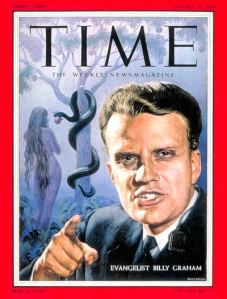
Where Is the Next Billy Graham Right Now?

John 3:16 says, “For God so loved the world, that he gave his only Son, that whoever believes in him should not perish but have eternal life.” This verse makes it clear God loves people. Regardless of who they are or what they have done, God loved them enough to send Jesus to die for them. When we see people who act differently than we do as Christians, we need to remember God’s desire that none perish and then share with them the good news of Jesus Christ.

In Russell Moore’s article “The Next Billy Graham Might Be Drunk Right Now,” we are given a perfect example of why it is important to be about making disciples. You never know what is going to become of the person to whom you are witnessing. Dr. Moore’s blog should also encourage us when we are not seeing a lot of decisions. If we are faithful to plant the seed of the gospel, God will see that it produces fruit.

I think this is the best article I have read in 2012, so I hope you enjoy “The Next Billy Graham Might Be Drunk Right Now.”

Whenever I start to get discouraged about the future of the church, I remember a conversation I had a few years ago with evangelical theologian Carl F. H. Henry on what would turn out to be his last visit to Southern Seminary before his death.

Several of us were lamenting the miserable shape of the church, about so much doctrinal vacuity, vapid preaching, non-existent discipleship. We asked Dr. Henry if he  saw any hope in the coming generation of evangelicals.

And I will never  forget his reply.

“Why, you speak as though Christianity were genetic,” he said. “Of  course, there is hope for the next generation of evangelicals. But the  leaders of the next generation might not be coming from the current  evangelical establishment. They are probably still pagans.”

“Who knew that Saul of Tarsus was to be the great apostle to the  Gentiles?” he asked us. “Who knew that God would raise up a C.S. Lewis, a  Charles Colson? They were unbelievers who, once saved by the grace of  God, were mighty warriors for the faith.”

Of course, the same principle applied to Henry himself. Who  knew that God would raise up a newspaperman from a nominally Lutheran  family to defend the Scriptures for generations of conservative  evangelicals?

The next Jonathan Edwards might be the man driving in front of you with the Darwin Fish bumper decal. The next Charles Wesley might be a misogynist, profanity-spewing hip-hop artist right now. The next Billy Graham might be passed out drunk in a fraternity house right now. The next Charles Spurgeon might be making posters for a Gay Pride March right now. The next Mother Teresa might be managing an abortion clinic right now.

But the Spirit of God can turn all that around. And seems to delight to do so. The new birth doesn’t just transform lives, creating repentance and faith; it also provides new leadership to the church, and fulfills Jesus’ promise to gift his church with everything needed for her onward march through space and time (Eph. 4:8-16).

After all, while Phillip was leading the Ethiopian eunuch to Christ, Saul of Tarsus was still a murderer.

Most of the church in any generation comes along through the slow, patient discipleship of the next generation. But just to keep us from thinking Christianity is evolutionary and “natural” (or, to use Dr. Henry’s term “genetic”), Jesus shocks his church with leadership that seems to come like a Big Bang out of nowhere.

Whenever I’m tempted to despair about the shape of American Christianity, I’m reminded that Jesus never promised the triumph of the American church; he promised the triumph of the church. Most of the church, in heaven and on earth, isn’t American. Maybe the hope of the American church is right now in Nigeria or Laos or Indonesia.

Jesus will be King, and his church will flourish. And he’ll do it in the way he chooses, by exalting the humble and humbling the exalted, and by transforming cowards and thieves and murderers into the cornerstones of his New City.

So relax.

And, be kind to that atheist in front of you on the highway, the one who just shot you an obscene gesture. He might be the one who evangelizes your grandchildren.

Click here to read more by Dr. Russell Moore.

Seven Reasons You May Never Accomplish Something Significant

As we begin 2012, Perry Noble gives us “7 Reasons You May Never Accomplish Something Significant.

1. Procrastination! (Remember, procrastination is assassination on the amazing future God has for you – James 1:22!)

2. You are allowing your past to identify you rather than Christ to identify you! (See I Corinthians 6:9-11!) You are not who you were…you are who you are in Christ (II Corinthians 5:17), and if you don’t let your past die, then it won’t let you live.

3. You are more obsessed with what others think about you rather than what Christ thinks about you! (See Colossians 3:2-3, Galatians 1:10)

4. You do not understand the fact that God’s Holy Spirit lives inside of you (Ephesians 1:13-14) and has gifted you and is calling you to do something greater than you could ever imagine (Ephesians 2:10, Ephesians 3:20)

5. You are afraid (see Isaiah 41:10) – and remember, anyone who ever accomplished anything significant for Christ had to take a significant step of faith (Hebrews 11:6!)

6. You believe the lie from hell that says you are an accident when Scripture says that God custom designed you (Psalm 139:13-16) and that you were clearly created on purpose, with a purpose and for a purpose.

7. You are obsessed with things that have ZERO significance when it comes to eternity (I John 2:17).

You can find this article and others like it at churchleaders.com.

Can You Resist the Temptation to Watch this Video?

I have always enjoyed reading articles when people are creative.  In this article by Mike Anderson, we see a creative new way to look at temptation as well as how to better handle them.  I hope this gives you valuable ammunition in your spiritual battles.

To read Mike Anderson’s post and watch the video follow this link: “Bet You Can’t Resist the Temptation to Watch This…!”