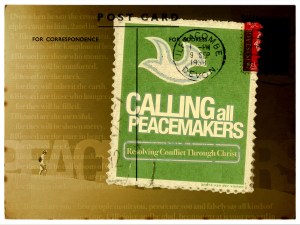
Helpful Hints for Dealing with Conflict

Throughout our lives we are going to have to deal with conflict. There are those who love conflict so they have someone to straighten out. Others are so uncomfortable with conflict that they seek peace at all cost—which is not really peace. Then there are those who will put off dealing with conflict as long as possible.  None of these approaches to conflict are healthy or Biblical.

Perry Noble gives some helpful advice on how to be deal with conflict in our lives.

Noble writes:

#1 – Email DOES NOT WORK!  (This would also apply to texting as well as any form of social media!)   

When conflict use to arise with me and someone in the office I used to walk to my desk, log on to my computer and fire off an abusive email, several problems with this…

  • It is the act of a coward, I would do this so that I would avoid a eye to eye conversation.
  • It removes the fact that I am actually dealing with another person…if I type an email I don’t have to look them in the eye and removing that obstacle allows me to say things to them through typing that I would NEVER say to them in person.
  • It often drags out the conflict way longer that it should be.
  • It can easily be misinterpreted, thus causing new conflicts.

#2 – Handle Conflict Quickly – The Bible is VERY clear in Ephesians 4:25-26 that we are not to allow the sun to go down while we are angry.  If we allow something to fester inside of us what usually comes out of that is NEVER pretty.

#3 – Always Assume The Best About The People You Work With – If you don’t get anything else in this article then PLEASE get this, LOVE ALWAYS ASSUMES THE BEST ABOUT SOMEONE…ALWAYS!  If you hate/can’t stand the people you work with then THE BEST thing to do is to begin to ask the Lord, “what is wrong with MY OWN heart?”

#4 – Remember that Email Does Not Work! 

#5 – Stop Expecting People To Read Your Mind – Often times people have said something hurtful to me that they did not perceive as hurtful.  I would become angry with them and actually tell myself, “well, they should just know that hurt me!”  NEWS FLASH – THEY DON’T KNOW, and they won’t know unless I am man enough to look them in the eye (because email does not work), assume the best about them (which automatically assumes they didn’t mean to hurt me) and CALMLY walk them through why what they said wounded me.

#6 – Stop Waiting For Them To Approach You – If you know there is conflict and you know there is a problem to be solved but you are “waiting on the right time” or “waiting on them to come to me” then I would encourage you to read what Jesus said in Matthew 5:23-24.  Maturity is when a person is willing to seize responsibility instead of just waiting on something to happen.

#7 – Never, EVER Go Public When You Have Not Even Attempted To Talk In Private – Too often people take their conflicts online when they have never even attempted to handle them in a private matter (sort of goes against what JESUS actually said in Matthew 18:15 as the first step in dealing with conflict!)  People are way too quick these days to read/hear something that someone says and automatically fire off a tweet or blog post without ever attempting to have a conversation with the person that they assume “got it wrong,” causing them to feel like they need to be the savior of the world by jumping to conclusions and making accusations about things that they actually have zero knowledge of.

#8 – And finally, do not forget that Email does not work! 

Are Christians Inconsistent with Old Testament Laws?

One of the main arguments used against Christians is that we are inconsistent with upholding all of the Old Testament Laws. Many Christians are not sure how to answer such a statement and end up leaving the conversation feeling defeated and confused.

Dr. Tim Keller helps better equip Christians as to how to answer this question in his post, “Making Sense of Scriptures’s ‘Inconsistency.'”

Keller writes:

I find it frustrating when I read or hear columnists, pundits, or journalists dismiss Christians as inconsistent because “they pick and choose which of the rules in the Bible to obey.” Most often I hear, “Christians ignore lots of Old Testament texts—about not eating raw meat or pork or shellfish, not executing people for breaking the Sabbath, not wearing garments woven with two kinds of material and so on. Then they condemn homosexuality. Aren’t you just picking and choosing what you want to believe from the Bible?”

I don’t expect everyone to understand that the whole Bible is about Jesus and God’s plan to redeem his people, but I vainly hope that one day someone will access their common sense (or at least talk to an informed theological adviser) before leveling the charge of inconsistency.

First, it’s not only the Old Testament that has proscriptions about homosexuality. The New Testament has plenty to say about it as well. Even Jesus says, in his discussion of divorce in Matthew 19:3-12, that the original design of God was for one man and one woman to be united as one flesh, and failing that (v. 12), persons should abstain from marriage and sex.

However, let’s get back to considering the larger issue of inconsistency regarding things mentioned in the Old Testament no longer practiced by the New Testament people of God. Most Christians don’t know what to say when confronted about this issue. Here’s a short course on the relationship of the Old Testament to the New Testament.

The Old Testament devotes a good amount of space to describing the various sacrifices offered in the tabernacle (and later temple) to atone for sin so that worshipers could approach a holy God. There was also a complex set of rules for ceremonial purity and cleanness. You could only approach God in worship if you ate certain foods and not others, wore certain forms of dress, refrained from touching a variety of objects, and so on. This vividly conveyed, over and over, that human beings are spiritually unclean and can’t go into God’s presence without purification.

But even in the Old Testament, many writers hinted that the sacrifices and the temple worship regulations pointed forward to something beyond them (cf. 1 Sam. 15:21-22; Ps. 50:12-15; 51:17; Hos. 6:6). When Christ appeared he declared all foods clean (Mark 7:19), and he ignored the Old Testament cleanliness laws in other ways, touching lepers and dead bodies.

The reason is clear. When he died on the cross the veil in the temple tore, showing that he had done away with the need for the entire sacrificial system with all its cleanliness laws. Jesus is the ultimate sacrifice for sin, and now Jesus makes us clean.

The entire book of Hebrews explains that the Old Testament ceremonial laws were not so much abolished as fulfilled by Christ. Whenever we pray “in Jesus name” we “have confidence to enter the Most Holy Place by the blood of Jesus” (Heb. 10:19). It would, therefore, be deeply inconsistent with the teaching of the Bible as a whole if we continued to follow the ceremonial laws.

Law Still Binding

The New Testament gives us further guidance about how to read the Old Testament. Paul makes it clear in places like Romans 13:8ff that the apostles understood the Old Testament moral law to still be binding on us. In short, the coming of Christ changed how we worship, but not how we live. The moral law outlines God’s own character—his integrity, love, and faithfulness. And so everything the Old Testament says about loving our neighbor, caring for the poor, generosity with our possessions, social relationships, and commitment to our family is still in force. The New Testament continues to forbid killing or committing adultery, and all the sex ethic of the Old Testament is re-stated throughout the New Testament (Matt. 5:27-30; 1 Cor. 6:9-20; 1 Tim. 1:8-11). If the New Testament has reaffirmed a commandment, then it is still in force for us today.

The New Testament explains another change between the testaments. Sins continue to be sins—but the penalties change. In the Old Testament sins like adultery or incest were punishable with civil sanctions like execution. This is because at that time God’s people constituted a nation-state, and so all sins had civil penalties.

But in the New Testament the people of God are an assembly of churches all over the world, living under many different governments. The church is not a civil government, and so sins are dealt with by exhortation and, at worst, exclusion from membership. This is how Paul deals with a case of incest in the Corinthian church (1 Cor. 5:1ff. and 2 Cor. 2:7-11). Why this change? Under Christ, the gospel is not confined to a single nation—it has been released to go into all cultures and peoples.

Once you grant the main premise of the Bible—about the surpassing significance of Christ and his salvation—then all the various parts of the Bible make sense. Because of Christ, the ceremonial law is repealed. Because of Christ, the church is no longer a nation-state imposing civil penalties. It all falls into place. However, if you reject the idea of Christ as Son of God and Savior, then, of course, the Bible is at best a mishmash containing some inspiration and wisdom, but most of it would have to be rejected as foolish or erroneous.

So where does this leave us? There are only two possibilities. If Christ is God, then this way of reading the Bible makes sense. The other possibility is that you reject Christianity’s basic thesis—you don’t believe Jesus is the resurrected Son of God—and then the Bible is no sure guide for you about much of anything. But you can’t say in fairness that Christians are being inconsistent with their beliefs to follow the moral statements in the Old Testament while not practicing the other ones.

One way to respond to the charge of inconsistency may be to ask a counter-question: “Are you asking me to deny the very heart of my Christian beliefs?” If you are asked, “Why do you say that?” you could respond, “If I believe Jesus is the resurrected Son of God, I can’t follow all the ‘clean laws’ of diet and practice, and I can’t offer animal sacrifices. All that would be to deny the power of Christ’s death on the cross. And so those who really believe in Christ must follow some Old Testament texts and not others.”