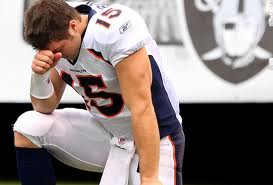
“Tim Tebow on Tebowing” By Anugrah Kumar

It’s the football off-season and Denver Broncos quarterback Tim Tebow made appearances in Las Vegas, Nevada, over the weekend and spoke to thousands of his Christian fans about “Tebowing,” printing Bibles verses on his eye black and what Jesus means to him.

The 3,000-seat Canyon Ridge Christian Church at Lone Mountain Road and Jones Boulevard could not hold the crowd Sunday and about 1,800 people had to sit under a tent outside to watch the service via video feed, according to Las Vegas Review-Journal.

The Christian football star, who had brought the Bible he has used since his high school days, showed Senior Pastor Kevin Odor how to “Tebow” and prayed for those hoping to welcome Christ into their hearts, the Journal reported.

On Saturday night, Tebow spent about 45 minutes talking with Pastor Odor at Canyon Ridge’s auditorium. “I’m pretty sure I’m not the first athlete to get on a knee and pray,” Las Vegas Sun quoted the casually dressed Tebow as saying. “It’s funny, I’ve been doing this same exact routine for the last seven years and for some reason this was the first year that people started talking about it.”

Why does he do it? “There’s all this excitement in a game, whether it’s playing the NFL or college, with all the hype,” he said. “You’re going to do good, you’re going to do bad and all the eyes are watching you and for me, it’s to be able to take a moment to block out everything else and just get on a knee and thank the Lord.”

One of the reasons he gets on a knee, he added, “is because that’s a form of humbling yourself. I want to humble myself before the Lord and say thank you for this opportunity. Thank you for letting me play the game I love. Whether I’m good or bad, whether I’m the hero or the goat, whether I score four touchdowns or throw four interceptions, that will still be the same person, honoring the Lord.”

Tebow also shared about the Bible verses he frequently wore on his eye black until it was banned in 2010. He said he chose Philippians 4:13 because “there’s not a better verse for an athlete.” It reads, “I can do all this through him who gives me strength.”

He contemplated changing passages – to John 3:16. “I told Coach (Urban) Meyer, and he said, ‘What?! That’s a good point, Tim, but Philippians 4:13 is what got us here.'” Tebow agreed not to change. But when he finally did during a national championship game against Ohio State, 94 million people did a Google search for John 3:16. “My first thought was how do 94 million people not know what John 3:16 is?” he said.

The verse, he added, presents the essence of what Christianity is. “It’s a verse that changed my life when I was a little boy,” he said. “It’s the essence of what I believe and that’s why I wanted to wear it, because it’s an amazing verse that has the power to change people’s lives.”

Tebow stressed the primacy of faith in his life. “You get bashed against the rocks sometimes,” he was quoted as saying. “But when you have a relationship with Christ … One of my favorite quotes is, ‘I don’t know what my future holds, but I know who holds it.’ I know what my rock is. I know who’s holding my future. It’s easy to get hurried and too busy and distracted from your priorities. Mine are faith, family and football, in that order. When those get jumbled up, you’re putting the wrong things first in life.”

He also mentioned during his appearance at the Las Vegas megachurch that his teammates would occasionally joke about him not cursing on the field. “Some of my linemen would come up to me and say, ‘What is that thing that stops the water in the middle of the river?’ and I said, ‘Dam?’ and they would laugh and say, ‘We got Tim to curse.'”


Does God Send People to Hell?

I cannot even begin to count the number of people over the years who have asked me, “What happens to people who never get to hear the gospel before they die?” They ask because they are genuinely concerned and wonder what will happen to the eternal souls of those who are never reached with the good news of Jesus Christ.

Justin Taylor deals with this subject in his study on Romans 1.18-21 entitled “What Unbelieving Pagans Know about God and Why They Are Responsible for It.” He makes it perfectly clear that each and every person is responsible for what they do with God. His study also shows us the importance of being ready to share Jesus with everyone we come into contact with.

Mr. Taylor writes:

I am continually amazed at how much dense theology Paul is able to pack into a few lines of a letter. Consider, for example, just four verses: Romans 1:18-21.

For the wrath of God is revealed from heaven against all ungodliness and unrighteousness of men, who by their unrighteousness suppress the truth. 19 For what can be known about God is plain to them, because God has shown it to them. 20 For his invisible attributes, namely, his eternal power and divine nature, have been clearly perceived, ever since the creation of the world, in the things that have been made. So they are without excuse. 21 For although they knew God, they did not honor him as God or give thanks to him, but they became futile in their thinking, and their foolish hearts were darkened.

Paul has just finished exulting in the “good news” of the gospel (Rom. 1:15-17), but he now begins to paint a contrasting backdrop of the “bad news” for those who rebel against their holy creator. Whereas “the righteousness of God is revealed from faith for faith” to all who believe (vv. 16-17), “the wrath of God is revealed from heaven” against all who suppress God’s truth (v. 18). Paul piles up the terms in reference to the godless Gentiles: on the one hand, “ungodliness and unrighteousness” describes what they do, and on the other hand “by their unrighteousness” is the way in which they go about their work of suppressing truth. The reality of the redundancy is repulsive: by their unrighteousness they perform unrighteousness.

Paul immediately grounds this programmatic statement with the important insight that “what can be known about God is plain to them” (v. 19). Paul is not saying that these unbelievers, apparently without access to special revelation, know everything there is to know about God, but rather that they know everything that has been commonly or generally revealed to all. That is, they know “what can be known.” How does Paul himself know this? How can he claim with certainty what every man knows about God? Has he interviewed them all? In line with his God-centered theology, Paul grounds his own certainty about this universal knowledge in God’s act of common revelation: “God has shown it to them” (v. 19b).

Paul now proceeds to explain  in verse 20 how this can be. Note four things.

First, the object of their knowledge is God’s “invisible attributes.” In particular, Paul points to God as Creator with eternality, power, and divinity (“eternal power and divine nature . . . creation of the world”).

Second, he explains the location of their knowledge of these invisible divine attributes: “in the things that have been made.” In other words, his invisible characteristics are found in his visible creation.

Third, he explains the duration of their knowledge, to the effect that this has always been the case: “ever since the creation of the world.”

Fourth, he points to the quality of their knowledge: it is “clearly perceived,” hearkening back to his comment that this knowledge is “plain to them.”

Paul adds all of this together and draws the inescapable conclusion (oun, so, therefore) for those who know God but suppress his truth: “they are without excuse.” None can plead ignorance, therefore none can excuse their moral responsibility and culpability.

Paul continues to explain what he means in verse 21. Their knowledge of God should lead to two appropriate responses, but instead we see two regrettable reversals: (1) they refused to honor God as God and (2) they refused to thank God for his wonderful gifts.

This then yields the two commensurate results: (1) they became futile in their thinking and (2) their foolish hearts were darkened.

In the remainder of this first chapter Paul unfolds the consequences for this knowledge-suppressing behavior, showing the further descent into the darkness of idolatry in light of God’s inaugurated eschatology of judgment.

Studying just these few verses gives us enormous insight into what the pagans know and why they are responsible. May it motivate us to bring the gospel to those who are both near and far.

“Judge Not That You Be Not Judged.” (Matthew 7.1)

Kevin DeYoung deals with this seemingly controversial verse in his article “Don’t Assume.

Mr. DeYoung writes:

It may be the best known Bible verse in our culture: “Judge not, that you be not judged” (Matt. 7:1).

As one of our society’s most popular verses, it is also one of the most misunderstood. Too many people, non-Christian and Christian, take Jesus’ words to be a blanket rejection of all moral evaluation. But given that Jesus alludes to his opponents as dogs and pigs five verses later, it’s safe to think Jesus wasn’t condemning every kind of judgment. We see from the rest of the Gospel that Matthew 7:1 is not inconsistent with strong criticisms, negative statements, church discipline, and warnings about hell. Judgmentalism is not the same as making ethical and doctrinal demands or believing others to be wrong.

And yet, after all the necessary qualifications, we must not mute this important command. As sinners, we are apt to assume the worst about people. We are eager to find favorable comparisons that make ourselves look good at the expense of others. We are quick to size people up and think we have them figured them out. But I have learned over the years–both as the giver and receiver of judgmental assumptions–that it’s best not to assume.

Don’t assume you know all the facts after hearing one side of the story.

Don’t assume the person is guilty just because strong charges are made against him.

Don’t assume you understand a blogger’s heart after reading one post.

Don’t assume that famous author, preacher, athlete, politician, or local celebrity won’t read what you write and don’t assume they won’t care what you say.

Don’t assume the divorced person is to blame for the divorce.

Don’t assume the single mom isn’t following Jesus.

Don’t assume the guy from the Mission is less of a man or less of a Christian.

Don’t assume the pastor looking for work is a bad pastor.

Don’t assume the church that struggles or fails is a bad church.

Don’t assume you’d be a better mom.

Don’t assume bad kids are the result of bad parents.

Don’t assume your parents are clueless.

Don’t assume everyone should drop everything to attend to your needs, and don’t assume no one will.

Don’t assume the rich are ungenerous.

Don’t assume the poor are lazy.

Don’t assume you know what they are all like after meeting one or two of their kind.

Don’t assume you should read between the lines.

Don’t assume you have interpreted the emotions of the email correctly.

Don’t assume everyone has forgotten about you.

Don’t assume they meant to leave you off the list.

Don’t assume everyone else has a charmed life.

Don’t assume a bad day makes her a bad friend.

Don’t assume the repentance isn’t genuine.

Don’t assume the forgiveness isn’t sincere.

Don’t assume God can’t change you.

Don’t assume God can’t love you.

Don’t assume God can’t love them.

A Psalm of Giving Thanks (Ps 100)

Make a joyful noise to the Lord, all the earth!  Serve the Lord with gladness! Come into his presence with singing!

3 Know that the Lord, he is God! It is he who made us, and  we are his;[a] we are his  people, and the sheep of his pasture.

4 Enter his gates with thanksgiving, and his courts with praise! Give thanks to him; bless his name!

5 For the Lord is good; his steadfast love endures forever, and his faithfulness to all generations.

From the English Standard Version of the Bible.

Bullets or Seeds

It would seem that in our day people no longer talk to each other when they have differing views. No, today they yell, criticize, mock, undermine, and sometimes even lie about each other. It is ridiculous the way people treat each other. I blame talk radio and presidential campaigns for setting the standard of how to treat those who are different.

I have met a lot of unchurched people who feel the same way about most Christians. They have been Continue reading