Real Bad

In a recent post, Timothy Keller discussed Jesus’ attitude toward all the difficulties, pain, and suffering we face.

Keller writes:

The story of Jesus standing before the tomb of Lazarus is an endless source of insight for me. As he was about to raise Lazarus from the dead, Jesus was not smiling. He was angry. He was weeping. Why? Because death is a bad thing! Jesus wasn’t thinking, ‘They think that this is a tragedy, but no harm done! I’m about to raise him from the dead. This looks like a bad thing, but it’s not. It’s really a good thing! It’s a way for me to show my glory. It’s really exciting! I can’t wait!’ He wasn’t thinking that. Jesus was weeping at the tomb, because the bad thing he’s about to work for good is bad. The story of Lazarus does not give you a saccharine view of suffering, saying bad things are really blessings in disguise or that every cloud has a silver lining. The Bible never says anything like that! God will give bad things good effects in your life, but they’re still bad. Jesus Christ’s anger at the tomb of Lazarus proves that he hates death. He also hates loneliness, alienation, pain, and suffering. Jesus hates it all so much that he was willing to come into this world and experience it all himself, so that eventually he could destroy it without destroying us.

There’s no saccharine view in the Christian faith. The promise is not that if you love God, good things will happen in your life. The promise is not that if you love God, the bad things really aren’t bad; they’re really good things. The promise is that God will take the bad things, and he’ll work them for good in the totality.”

Many people have questioned God’s love for them after they have placed their faith in Christ. They don’t understand why they still suffer even though they are a Christian. Like the seed sown in the shallow soil they wither under the heat of discomfort and eventually turn away from God completely.

Jesus never promised us a life without trouble, in fact He actually told us in this life we would have troubles (John 16.33). Jesus didn’t come to give us our hearts desire. He came to deliver us from God’s wrath. He came to give us life eternal in heaven. He came because of His great love for us.

Tomorrow we will continue our study of Jesus’ “I Am” statements in the book of John. As we look at the broader story around Jesus’ declaration, “I am the resurrection and the life” (John 11.25) we will discover some of the similarities of Lazarus being raised from the dead physically and our being raised spiritually.

I hope to see you Resurrection Sunday at 10:45 a.m. as we celebrate Jesus’ victory over sin, death, hell, and the grave.

Here is a link for directions to Living Oaks Baptist Church.
Seed of Promise

With Resurrection Sunday only a few days away, I think the article “Seed of Promise” by Margaret Manning helps put the necessity of Christ’s death in perspective.

Ms. Manning writes:

“Unless a grain of wheat falls into the earth and dies, it remains by itself, alone; but if it dies, it bears much fruit.”(1) 

His hour had come. He had walked among them, taught them, performed miraculous signs, and he had loved and cared for them. But now, his hour had come and the cross lay ahead of him. The “hour” he faced would be filled with trial and suffering: “Now, my soul has become troubled and what shall I say, ‘Father, save me from this hour?'” 

Jesus would walk the long, lonely road to the cross. Rather than taking the way of self-preservation, he would offer his life, like a grain of wheat. He would die; he would be buried in the darkness of the earth, but as a result he would bear much fruit. Despite what lay ahead of him, and despite the trouble in his soul, he affirms, “For this purpose I came to this hour. Father, glorify your name.” 

Of what was transacted there on that cross, there are many theories.(2) In formal theology, these “theories” attempt to get at the very nature and the very essence of what Jesus accomplished through his death. For theologians, atonement studies are a fertile field of inquiry because the meaning and impact of the atonement are rich, complex, and paradoxical. One theory, for example, suggests that the atonement stands as the preeminent example of a sacrificial life. Other theories argue that the cross is the ultimate symbol of divine love, or that the cross demonstrates God’s divine justice against sin as the violation of his perfect law. Still other theories suggest the cross overcame the forces of sin and evil, restored God’s honor in relation to God’s holiness and righteousness, or served as a substitution for the death we all deserved because of sin. 

While the nature of the atonement may include a portion of all of these theories, Jesus’s statements as recorded in John’s gospel indicate that his death would be a path to abundant life resulting in the production of much fruit. And in this case, Jesus doesn’t construct a theory of the atonement, but instead chooses an agrarian image to indicate what would be accomplished in the cross. “The hour has come for the Son of Man to be glorified… unless a grain of wheat falls into the earth and dies, it remains by itself alone, but if it dies, it bears much fruit” (John 12:23-24). Charles Spurgeon, the nineteenth century theologian and preacher, wrote that this passage of Scripture is rich with paradoxical statements describing the nature of atonement: 

“[P]aradox is this—that his glory was to come to him through shame…[that] the greatest fulness of our Lord’s glory arises out of his emptying himself, and becoming obedient to death, even the death of the cross. It is his highest reputation that he made himself of no reputation. His crown derives new luster from his cross….We must never forget this, and if ever we are tempted to merge the crucified Saviour in the coming King we should feel rebuked by the fact that thus we should rob our Lord of his highest honour.”(3) 

Spurgeon expands on the paradoxical nature of death-bringing forth life. It is only through the cross, just as a kernel of wheat must die in order to produce a harvest, that new life in Christ and reconciliation with God are accomplished. Most powerfully, Spurgeon notes that “this teaches us where the vital point of Christianity lies, Christ’s death is the life of his teaching. See here: if Christ’s preaching had been the essential point, or if his example had been the vital point, he could have brought forth fruit and multiplied Christians by his preaching, and by his example. But he declares that, except he shall die, he shall not bring forth fruit.”(4) 

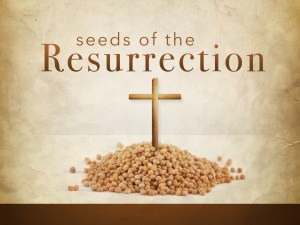
We see this paradox borne out every spring. Dead bulbs ugly, brown, and buried in dark soil all winter burst from their earthen tomb green with life and bright with color. Their glory disguised in ugly packaging, and one bulb producing green leaves and flowers in abundance. So it is with Jesus’s passion and death: glory and abundance come out of sorrow, shame, death and suffering. Encased in the cross of Golgotha is a beautiful, life-giving seed. 

Long before the beauty of Easter morning, a tiny kernel of wheat dies; it lays buried seemingly dead underground. This is a great paradox, but one in which we can come to glory, one in which we can find our lives. 

See from his head, his hands, his feet Sorrow and love flow mingled down Did ere such love and sorrow meet Or thorns compose so rich a crown?(5) 

Margaret Manning is a member of the writing and speaking team at Ravi Zacharias International Ministries in Seattle, Washington.  

(1) John 12:24. (2) The following theories of the atonement are based upon Millard Erickson’s Christian Theology (Grand Rapids: Baker Books, 1983), 781-823. (3) “The Corn of Wheat Dying to Bring Forth Fruit: John 12:23-25,” Charles H. Spurgeon, Farm Sermons (c 1875), from http://textweek.com, accessed April 2, 2009. (4) Ibid. (5) “When I Survey the Wondrous Cross,” written by Isaac Watts, 1707.

The Resurrection Facts

As Christians we are to be growing in our understanding of Scripture. There are those who would challenge even the most basic of our beliefs such as the resurrection of Jesus. Without a firm foundation of doctrinal truths we will never be able to defend our faith. For years William Lane Craig has been one of the leading defenders of Christian faith. His work as found on Reasonable Faith has helped “to train Christians to state and defend Christian truth claims with greater effectiveness.”

With Easter rapidly approaching, I believe his article “The Resurrection of Jesus” is a great tool to help us express the truth of Jesus’ resurrection as fact and not just the opinion of Christians.

Please follow this link “The Resurrection of Jesus” to read the complete article on CBN.COM.

To read more by William Lane Craig please visit his site: Reasonable Faith.

Christian Doubt

Here is a short article by Darrell Bock for those who may be doubting their Christian faith.

“Christian Doubt” by Darrell Bock