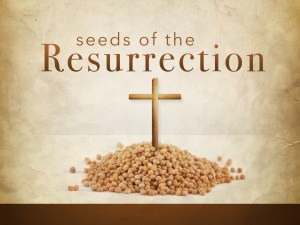
Seed of Promise

With Resurrection Sunday only a few days away, I think the article “Seed of Promise” by Margaret Manning helps put the necessity of Christ’s death in perspective.

Ms. Manning writes:

“Unless a grain of wheat falls into the earth and dies, it remains by itself, alone; but if it dies, it bears much fruit.”(1) 

His hour had come. He had walked among them, taught them, performed miraculous signs, and he had loved and cared for them. But now, his hour had come and the cross lay ahead of him. The “hour” he faced would be filled with trial and suffering: “Now, my soul has become troubled and what shall I say, ‘Father, save me from this hour?'” 

Jesus would walk the long, lonely road to the cross. Rather than taking the way of self-preservation, he would offer his life, like a grain of wheat. He would die; he would be buried in the darkness of the earth, but as a result he would bear much fruit. Despite what lay ahead of him, and despite the trouble in his soul, he affirms, “For this purpose I came to this hour. Father, glorify your name.” 

Of what was transacted there on that cross, there are many theories.(2) In formal theology, these “theories” attempt to get at the very nature and the very essence of what Jesus accomplished through his death. For theologians, atonement studies are a fertile field of inquiry because the meaning and impact of the atonement are rich, complex, and paradoxical. One theory, for example, suggests that the atonement stands as the preeminent example of a sacrificial life. Other theories argue that the cross is the ultimate symbol of divine love, or that the cross demonstrates God’s divine justice against sin as the violation of his perfect law. Still other theories suggest the cross overcame the forces of sin and evil, restored God’s honor in relation to God’s holiness and righteousness, or served as a substitution for the death we all deserved because of sin. 

While the nature of the atonement may include a portion of all of these theories, Jesus’s statements as recorded in John’s gospel indicate that his death would be a path to abundant life resulting in the production of much fruit. And in this case, Jesus doesn’t construct a theory of the atonement, but instead chooses an agrarian image to indicate what would be accomplished in the cross. “The hour has come for the Son of Man to be glorified… unless a grain of wheat falls into the earth and dies, it remains by itself alone, but if it dies, it bears much fruit” (John 12:23-24). Charles Spurgeon, the nineteenth century theologian and preacher, wrote that this passage of Scripture is rich with paradoxical statements describing the nature of atonement: 

“[P]aradox is this—that his glory was to come to him through shame…[that] the greatest fulness of our Lord’s glory arises out of his emptying himself, and becoming obedient to death, even the death of the cross. It is his highest reputation that he made himself of no reputation. His crown derives new luster from his cross….We must never forget this, and if ever we are tempted to merge the crucified Saviour in the coming King we should feel rebuked by the fact that thus we should rob our Lord of his highest honour.”(3) 

Spurgeon expands on the paradoxical nature of death-bringing forth life. It is only through the cross, just as a kernel of wheat must die in order to produce a harvest, that new life in Christ and reconciliation with God are accomplished. Most powerfully, Spurgeon notes that “this teaches us where the vital point of Christianity lies, Christ’s death is the life of his teaching. See here: if Christ’s preaching had been the essential point, or if his example had been the vital point, he could have brought forth fruit and multiplied Christians by his preaching, and by his example. But he declares that, except he shall die, he shall not bring forth fruit.”(4) 

We see this paradox borne out every spring. Dead bulbs ugly, brown, and buried in dark soil all winter burst from their earthen tomb green with life and bright with color. Their glory disguised in ugly packaging, and one bulb producing green leaves and flowers in abundance. So it is with Jesus’s passion and death: glory and abundance come out of sorrow, shame, death and suffering. Encased in the cross of Golgotha is a beautiful, life-giving seed. 

Long before the beauty of Easter morning, a tiny kernel of wheat dies; it lays buried seemingly dead underground. This is a great paradox, but one in which we can come to glory, one in which we can find our lives. 

See from his head, his hands, his feet Sorrow and love flow mingled down Did ere such love and sorrow meet Or thorns compose so rich a crown?(5) 

Margaret Manning is a member of the writing and speaking team at Ravi Zacharias International Ministries in Seattle, Washington.  

(1) John 12:24. (2) The following theories of the atonement are based upon Millard Erickson’s Christian Theology (Grand Rapids: Baker Books, 1983), 781-823. (3) “The Corn of Wheat Dying to Bring Forth Fruit: John 12:23-25,” Charles H. Spurgeon, Farm Sermons (c 1875), from http://textweek.com, accessed April 2, 2009. (4) Ibid. (5) “When I Survey the Wondrous Cross,” written by Isaac Watts, 1707.


At Peace With God’s Pace

Graceway MediaThis morning I would like to introduce you to Steve Roll, founder of Restoration Ministries. Steve is a godly man who longs to see others enjoy the healthy spiritual life God has planned for them. He has committed his life to be a helping hand and word of encouragement to those who are hurting.

I believe his insightful post, “At Peace With God’s Pace,” will give you simple advice on how to enjoy the life you’ve been given. Personally, I want to go through life at a pace which allows me to enjoy living. I don’t want to live at a frenetic pace feeling like a contestant on “The Amazing Race” going to different places but never having time to enjoy them.  God’s pace will always allow us time to smell the roses.

I pray Steve’s post, “At Peace With God’s Pace,” will bring you hope of enjoying life and not just rushing through it!

“The steadfast of mind Thou wilt keep in perfect peace because he trusts in Thee.” Isaiah 26:3
 “The steps of a man are established by the Lord, and He delights in his way.” Psalm 37:23

“Are we there yet?” Like kids on a vacation trip trapped in the backseat of the car—we are an impatient people. Rather than enjoy the journey, we clamor to arrive at our destination. And we want to be there NOW!

Everyone is in such a hurry today. You and I run here and there, and there and here, like chickens with our heads cut off.  We have been duped into thinking that the fast lane of the rat race is where it’s at. Who says we have to run the rat race? I guess the rats do! So many people labor and live at a breakneck, feverish pace in order to keep up with the Joneses. If I read my Bible right, Christians are to keep up with Jesus, not the Jones. 

When you study the life of Christ, you find that He paced Himself during His three year ministry. His steps were established (ordered, directed, laid out) by the Father. You never see Jesus stressed out. The Lord never put pressure on Himself to perform or be successful. In the midst of intense opposition and adversity, Jesus experienced the peace of God. Why? Because I believe He was at peace with God’s pace on the way to the cross and resurrection.  

Someone said hurry is often the long way around in life. Hurry, scurry, and worry keep many people frustrated. Many people lack inner peace in their lives because they don’t pace themselves. No wonder we have so many stressed out, burned out, freaked out people in our society. 

I have always been a high energy person. At times, high gear has been my Achilles heel. As a young boy, I remember watching my first long distance track race. The starter’s gun sounded, the runners took off.  I was so disappointed that the runners weren’t sprinting and running in highest gear. The race was 5,000 meters. The distance runners knew something I didn’t. 

They understood the principle of PACE. To complete the race, they had to pace themselves over the distance. They couldn’t possibly run the whole course full throttle. They would run out of gas before the finish line if they ran full blast.
As Christians, we are running a faith race (Hebrews 12:1-3). The Lord’s will is for us to finish our faith race victoriously (II Timothy 4:7-8). It’s to our benefit that we run our race at His pace. If we run ahead of God, we will burnout. If we run behind God, we rust out. But if we run with God, hand in hand with Him in the power of the Holy Spirit, we WIN OUT!

God is a god of peace and pace. He is never in a hurry, He never worries, and He is never late or ahead of schedule. He is perfectly on time, all the time. His secret: a planned, purposeful, peaceful, productive PACE. God’s universe and Kingdom is one of peace when His creatures live life at His pace. A restful, productive pace that energizes us is God’s way.  

Isaiah makes it crystal clear: Perfect peace is ours when we steadfastly focus on the Lord and trust Him to quicken the pace or slow it down. Note it is God’s perfect peace that the trusting person will receive. God’s perfect, complete, whole, fulfilling, satisfying peace is something we cannot produce ourselves.  Our Heavenly Father is the god of peace who gives peace to His children. 

I don’t know about you, but most of the time my problem with pace is not going too slow, but going too fast. Through the school of hard knocks, my hard head is learning that God loves me so much He will find a way to slow me down when necessary!
If we desire to be healthy, peaceful, and productive, we must come to terms with being at peace with God’s pace. If you are out of sync with God’s pace, fall on your face before Him. Confess your impatience. Repent of your dysfunctional desire to control outcomes and have things your way in your time. 

Slow down long enough to receive God’s peace. As you fix your mind on Him, His perfect peace will flood your heart. Trust Him to direct your steps and to show you the proper pace to run your race. 

You and I are off and running into God’s plan for us in 2012. Great opportunities lie ahead for us to glorify God. Peace with His pace will produce less stress and more success in our lives. So let’s commit ourselves to run our race at His pace this year.

“For you shall go out with joy, and be led forth with peace; the mountains and the hills shall break forth before you into singing, and all the trees of the field shall clap their hands.” Isaiah 55:15
“Great peace have those who love God’s law; nothing shall cause them to stumble.” Psalm 119:165

A Word For Your Week:  Christian winners run their race at God’s pace.

Eternal Comfort

In Matthew 5:4 Jesus says, “Blessed are those who mourn, for they shall be comforted.” Without a doubt those who are born again in Jesus Christ find comfort in this life. Often we have to endure great trials, but with the Holy Spirit we are always comforted.  We may be in the midst of a deadly tempest and yet the Holy Spirit will give us a peace that surpasses all understanding (Philippians 4:7).  Regardless of where we find ourselves in the brief existence we call life, Jesus has promised us eternal comfort with Him in heaven.

“Then I saw a new heaven and a new earth, for the first heaven and the first earth had passed away, and the sea was no more. And I saw the holy city, new Jerusalem, coming down out of heaven from God, prepared as a bride adorned for her husband. And I heard a loud voice from the throne saying, “Behold, the dwelling place of God is with man. He will dwell with them, and they will be his people, and God himself will be with them as their God. He will wipe away every tear from their eyes, and death shall be no more, neither shall there be mourning, nor crying, nor pain anymore, for the former things have passed away.”   (Revelation 21:1-4 ESV)