
Does God Send People to Hell?

I cannot even begin to count the number of people over the years who have asked me, “What happens to people who never get to hear the gospel before they die?” They ask because they are genuinely concerned and wonder what will happen to the eternal souls of those who are never reached with the good news of Jesus Christ.

Justin Taylor deals with this subject in his study on Romans 1.18-21 entitled “What Unbelieving Pagans Know about God and Why They Are Responsible for It.” He makes it perfectly clear that each and every person is responsible for what they do with God. His study also shows us the importance of being ready to share Jesus with everyone we come into contact with.

Mr. Taylor writes:

I am continually amazed at how much dense theology Paul is able to pack into a few lines of a letter. Consider, for example, just four verses: Romans 1:18-21.

For the wrath of God is revealed from heaven against all ungodliness and unrighteousness of men, who by their unrighteousness suppress the truth. 19 For what can be known about God is plain to them, because God has shown it to them. 20 For his invisible attributes, namely, his eternal power and divine nature, have been clearly perceived, ever since the creation of the world, in the things that have been made. So they are without excuse. 21 For although they knew God, they did not honor him as God or give thanks to him, but they became futile in their thinking, and their foolish hearts were darkened.

Paul has just finished exulting in the “good news” of the gospel (Rom. 1:15-17), but he now begins to paint a contrasting backdrop of the “bad news” for those who rebel against their holy creator. Whereas “the righteousness of God is revealed from faith for faith” to all who believe (vv. 16-17), “the wrath of God is revealed from heaven” against all who suppress God’s truth (v. 18). Paul piles up the terms in reference to the godless Gentiles: on the one hand, “ungodliness and unrighteousness” describes what they do, and on the other hand “by their unrighteousness” is the way in which they go about their work of suppressing truth. The reality of the redundancy is repulsive: by their unrighteousness they perform unrighteousness.

Paul immediately grounds this programmatic statement with the important insight that “what can be known about God is plain to them” (v. 19). Paul is not saying that these unbelievers, apparently without access to special revelation, know everything there is to know about God, but rather that they know everything that has been commonly or generally revealed to all. That is, they know “what can be known.” How does Paul himself know this? How can he claim with certainty what every man knows about God? Has he interviewed them all? In line with his God-centered theology, Paul grounds his own certainty about this universal knowledge in God’s act of common revelation: “God has shown it to them” (v. 19b).

Paul now proceeds to explain  in verse 20 how this can be. Note four things.

First, the object of their knowledge is God’s “invisible attributes.” In particular, Paul points to God as Creator with eternality, power, and divinity (“eternal power and divine nature . . . creation of the world”).

Second, he explains the location of their knowledge of these invisible divine attributes: “in the things that have been made.” In other words, his invisible characteristics are found in his visible creation.

Third, he explains the duration of their knowledge, to the effect that this has always been the case: “ever since the creation of the world.”

Fourth, he points to the quality of their knowledge: it is “clearly perceived,” hearkening back to his comment that this knowledge is “plain to them.”

Paul adds all of this together and draws the inescapable conclusion (oun, so, therefore) for those who know God but suppress his truth: “they are without excuse.” None can plead ignorance, therefore none can excuse their moral responsibility and culpability.

Paul continues to explain what he means in verse 21. Their knowledge of God should lead to two appropriate responses, but instead we see two regrettable reversals: (1) they refused to honor God as God and (2) they refused to thank God for his wonderful gifts.

This then yields the two commensurate results: (1) they became futile in their thinking and (2) their foolish hearts were darkened.

In the remainder of this first chapter Paul unfolds the consequences for this knowledge-suppressing behavior, showing the further descent into the darkness of idolatry in light of God’s inaugurated eschatology of judgment.

Studying just these few verses gives us enormous insight into what the pagans know and why they are responsible. May it motivate us to bring the gospel to those who are both near and far.
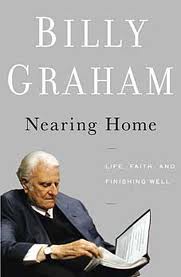

“Growing Old Has Been A Surprise” by Billy Graham

Billy Graham, in his book “Nearing Home: Life, Faith, and Finishing Well” (pp. 1-2, Thomas Nelson), he writes:

Growing old has been the greatest surprise of my life. The young live for the here and now. Thinking ahead seems to be in the form of dreams that promise fairy-tale endings. Though I am nearing ninety-three, it doesn’t seem so long ago that I was one of those dreamers, filled with great expectation, planning a life that Continue reading

Sometimes You Just Need a Crutch

Recovering from a broken leg is never easy. The first few days after surgery to screw my leg back together proved challenging in trying to deal with the pain. Because of a simple mistake I had to endure horrible pain after my nerve block wore off (See yesterday’s post, “Never Blocks Don’t Last Forever!”). By the end of the second day my pain was back under control and I was ready to begin physical therapy and get back to a normal life.

Within a few days I began to realize that dealing with the pain may have Continue reading

You’re Not Home Yet

An old missionary couple had been working in Africa for years and were returning to New York to retire. They had no pension; their health was broken; they felt defeated, discouraged, and afraid.

As the trip began, they discovered they were on the same ship as President Teddy Roosevelt, who was returning from one of his big-game hunting expeditions.

No one paid any attention to them. They watched the fanfare that accompanied the President’s entourage, with passengers trying to catch a glimpse of the great man. As the ship moved across the ocean, the old missionary said to his wife, “Something is wrong.”

“Why should we have given our lives in faithful service for God in Africa all these many years and have no one care a thing about us? Here this man comes back from a hunting trip and everybody makes much over him, but nobody gives two hoots about us.”

“Dear, you shouldn’t feel that way,” his wife said.

He replied “I can’t help it; it just doesn’t seem right.”

When the ship docked in New York, a band was waiting to greet the President. The mayor and other dignitaries were there. The papers were full of the President’s arrival. No one noticed the missionary couple. They slipped off the ship, disappeared in the crowd, and found a cheap flat on the East Side, hoping the next day to see what they could do to make a living in the city.

That night the man’s spirit broke. He said to his wife, “I can’t take this; God is not treating us fairly.” His wife replied, “Why don’t you go in the bedroom and tell that to the Lord?”

A short time later he came out from the bedroom, but now his face was completely different. His wife asked, “Dear, what happened?”

The Lord settled it with me. I told Him how bitter I was that the President should receive this tremendous homecoming, when no one met us as we returned home. And when I finished, it seemed as though the Lord put His hand on my shoulder and simply said;

“You’re not home yet.”

Author unknown

The Perfect Investment

Graceway MediaI remember a few years ago when the stock market crashed.  Regardless of how much power, prestige, or prominence you possessed, it wasn’t going to help protect your investments. Each month I would get a statement showing what was happening with the small nest egg I had been putting back for my retirement.  It is not a lot of money, but it is my money, which I would like to see grow and not disappear. Everyone I talked to told me that I could move it into different accounts that would prevent or minimize the losses; however, they also warned that when the market rebounded the initial jump would get me the biggest gains on my investments, and that waiting it out would be best. As most of you remember, those where difficult months to just lose years of savings.

I have a great desire to be a good steward of all God has entrusted to me.  I want to take care of and properly use all that I have.  I want to make wise investments now that enable me to help others after I retire in ways which are not possible today. In order to do that, I have to be disciplined to dream of the future and not just live for today’s pleasures.

I think this principle was instilled in me way back in Sunday School. I still remember Jesus’ saying in Matthew 6:19-20, “Do not lay up for yourselves treasures on earth, where moth and rust destroy and where thieves break in and steal, but lay up for yourselves treasures in heaven, where neither moth nor rust destroys and where thieves do not break in and steal. For where your treasure is, there your heart will be also” (ESV).

“Lay up for yourselves treasures in heaven” is a concept most people struggle with.  We want our best life NOW! We want a new car and a bigger house every couple of years. We want fancier toys (boats, camper, Jet Ski, golf clubs, guns, video games, electronic devices, etc.) to play with. We even want an annual raise so we can get more toys, but if we don’t get the raise we can always count on VISA, MasterCard, Discover Card, or American Express to get us our wants. We have a strong desire to store up for ourselves treasures on earth, right?

There are many problems with this mentality, but the biggest is we only have a few years to enjoy these toys. Our life is but a vapor. We have maybe seventy years to enjoy these things, and we definitely can’t take them with us. How many times have you seen a hearse on the way to the cemetery with a U-Haul trailer in tow? The treasures of this life have to be protected, repaired, maintained, and insured. We worry about whether they will last, be stolen, break, or even fulfill our desire for fun.

This should make Jesus’ statement to store up treasure in heaven where they last for eternity much more desirable. You see, we may not be able to take our stuff with us, but we can send it on ahead! We can make investments that will last beyond time and throughout eternity. Personally, I have found that investing my God-given gifts according to His commands have resulted in greater joy than any material possession I could have purchased. I have seen families blessed with a car to get to work, groceries to get through another week, a meal after the loss of another family member, and training for job. I know missionaries who are taken care of so they can share the gospel in other countries, I know of villages that have received chicks, ducks, goats, cattle, and even had a fresh water well dug for them.  All these things happened because a group of people decided to think about storing up treasure in heaven. What is their gift in this life? Joy! Unspeakable JOY! Joy in knowing a child will get a meal, joy in knowing that a family has a roof over their head, joy from watching a soul come to the saving knowledge of Jesus Christ.

There are a lot of things I could do with the money I give to the church each year, but none of them would bring me the eternal joy and satisfaction which I have found by investing in the treasures of heaven!