 Have you ever wondered why the experiences of those we read about in the Bible are important? How do they relate to us today in the twenty-first century? What can we learn from God appearing to Adam, Eve, Moses, Abraham, or Jacob? Justin Holcomb answers these questions in his post “The Ultimate Theophany.”
Holcomb writes:
The topic of theophany is often neglected in biblical and theological studies, though it is very important. Theophanies are instances of divine self-revelation in which God manifests himself to humans (the word “theophany,” which means “appearance of God,” comes from the Greek roots theo [God] and phaino [to appear]). While theophanies occur in different forms in Scripture, the content of a theophany is always the same. Theophanies consistently show God graciously revealing himself and his covenantal promises to his people.
Types of Theophanies
Mosaic Theophanies: No figure in Scripture had as many encounters with God through theophanies as Moses. God appeared to Moses in the fire of a burning bush (Ex. 3:1-6), causing Moses to hide his face. At Mt. Sinai, Moses went up to the mountaintop to worship God. He saw God at a distance and was invited into God’s presence, remaining there for 40 days. Later, Moses met “face to face” with God (Ex. 33:11; cf. Num. 14:14; Deut. 34:10). This expression hints at the intimate nature of theophanies. Even though Moses experienced a special and intimate relationship with God, he did not experience full revelation. Moses asked God to reveal his full glory to him, but God refused, telling Moses that no one could see God’s face and live (Ex. 33:20). So God passed by Moses, allowing him to see his back (Ex. 33:21-23).
Judgment Theophanies: Many scholars consider Genesis 3:8 to be the first theophany in Scripture. Adam and Eve heard the Lord walking in the garden and hid themselves from his presence. Gordon-Conwell professor Jeffrey Niehaus translates the phrase “cool of the day” as “in the wind of the storm,” based on a rare use of a specific Hebrew word. God often appeared in a threatening form when he was coming to bring judgment. After Adam and Eve sinned, God’s presence was dreadful, declaring judgment for their wrongdoing. Similarly, God revealed himself as a warrior before the Israelites overtook Jericho (Josh. 5:13-15). As Tremper Longman writes, a judgment theophany, “though always threatening, brings both curse and fear to God’s enemies and blessing and comfort to God’s people (Na. 1:1-9).”
Covenant Theophanies: God’s appearances to individuals in the Old Testament were frequently connected to his covenantal dealings with them. Specifically, God revealed himself in theophanies to provide assurance that he would maintain his end of the covenant (Gen. 26:24; 28:12-13; 35:1, 9; 48:3). For example, after Abraham arrived at Canaan, God appeared to him, promising that Abraham’s offspring would inherit the land (Gen. 12:7) in accordance with God’s covenant promises. God appeared to Abraham in human form before Isaac’s birth, assuring Abraham and Sarah that they would conceive a child in fulfillment of God’s promise to Abraham. Additionally, God manifested himself in human form to wrestle Jacob in order to get him to embrace his covenant blessing (Gen. 32:24). By the end of the narration, Jacob is certain that he had met God “face to face” (Gen. 32:30).
The Ultimate Theophany
God’s self-revelation culminates in the incarnation of Jesus, making him the ultimate theophany. Those who saw the face of Jesus saw the Father (John 14:9), experiencing a much more profound theophany than Moses did. Moses asked to see God’s glory, and those who lived with Jesus received what Moses had asked for (John 1:18). Carl Henry writes in God, Revelation, Authority:
The New Testament channels all interest in the theophanies of God into the divine manifestation in Jesus Christ; the Old Testament (Septuagint) term for theophanic appearances is, in fact, used of the resurrection appearances of Jesus Christ (ōphthē, 1 Cor. 15:5-8).
Jesus is also the ultimate “judgment theophany.” He declares judgment on those who reject him (John 3:18) yet provides comfort and blessing for those who would come to him and receive the mercy of God. Jesus brings judgment by revealing the high demands of God’s righteousness (Matt. 5:48) and the depths our desperate condition under sin; his substitutionary death reveals the weight of the curse, which could only be lifted through the death of the Son of God: “By sending his own Son in the likeness of sinful flesh and for sin, [God] condemned sin in the flesh” (Rom. 8:3). This is the ultimate judgment theophany, one that leads to hope and salvation.
Again, Jesus is the ultimate “covenant theophany.” Jesus, as God, ushered in the final covenant in “in his blood” (Matt 26:28), the new covenant. In Jesus, God himself looked into the eyes of his disciples and promised to be true to his word. Jesus reveals the ultimate, eternal covenant (Heb. 13:20) between God and his people.
Why Do Theophanies Matter?
1. God is with us. Theophanies remind us of the famous words of Francis Schaeffer: “He is there and he is not silent.” God has not and will not leave his people to suffer in isolation. He will “descend far beneath his loftiness,” as John Calvin said, and reassure us that he will do as he promised. “I will be their God and they will be my people” (Jer. 24:7) summarizes the covenant promise that runs all through the Bible, and theophanies point to this comforting reality.
2. God is holy, awesome, and majestic. Theophanies should humble us. Our God is a consuming fire (Heb. 12:29). All the various pictures of Yahweh in the Old Testament highlight this truth. Theophanies, according to Walter Elwell and Barry Beitzel, “conveyed a sense of the awesome majesty and power of God who is to be approached only with reverence and humility according to divinely prescribed procedures.” Ultimately, God’s holiness is most clearly seen in his wrath against sin, revealed and satisfied at the cross of Jesus.
3. God condescends to us. Theophanies point to God’s gracious condescension to our weakness. Theophanies are visual—they give tangible and physical proof of God. In a sense, they are God “writing it in the sky” for us. Though God wants us to trust him even when we can’t see him (“Blessed are those who have not seen and yet have believed,” John 20:29), theophanies offer a glimpse into the heart of our God who graciously condescends to help and comfort those who join Thomas in unbelief.

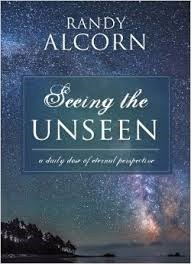 This book by Randy Alcorn has become a source of great encouragement this year. In a fast-paced world it is not uncommon for us to get too focused on the here and now. “Seeing the Unseen: A Daily Dose of Eternal Perspective” helps redirect my thoughts to my real home—HEAVEN! Everything God has created is good, but it has been given to us as a gift to draw our attention to the Giver, the Creator, to God Himself. This book will help keep your mind focused on the eternal.
 Bob Pittenger