Child-like Faith

And Jesus said,
“Truly, I say to you, whoever does not receive the kingdom of God like a child
shall not enter it.” (Mark 10.15 ESV)

A few weeks ago we were watching a story on the evening news about a
car that had hit a motorcycle.  The motorcycle was on fire, and its rider was trapped under the car.  The flames were consuming the bike and had spread to the engine of the car, and yet, people were desperately trying to get the young man out from under the car, thus putting their own lives in danger. Dozens of people rushed to the car, lifted it up so that another man could pull the injured rider to safety, set the car down, and backed away from the dangerous fire.  It was an act of selfless heroism.

 As I sat in my recliner watching this unfold I just kept saying, “That is unbelievable!  In today’s world you just don’t expect people to react like that.” I was truly pleasantly surprised that people would rally together, put their lives in jeopardy, and then do what was necessary to save someone else’s life.  No sooner had the words left my mouth when my seven-year-old son said, “Dad, isn’t it great that God sent all those people to help that man!”  Needless to say, I now was speechless.  Child-like faith has a way of putting things into perspective.

 In Mark 10:15, Jesus tells us to enter His Kingdom we need child-like faith.  Children believe what we tell them.  The Bible says God is gracious, merciful, kind, loving, generous, our defender, supplier, and meets all our needs.  In spite of this, adults tend to get caught up looking at the problem instead of the problem solver.  We end up focusing on the seen rather than unseen.  We walk by sight rather than by faith.  Children do not have that problem–they simply believe what they are taught and walk by pure faith.

 As you go about your day, keep your eyes of faith open to see the wonders which God is working all around you. You never know, it might be your hands that God uses to rescue someone from perishing.

I’m Going to be a Dad?

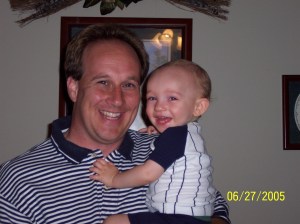
In my office, on the wall above my computer monitor, is a present my wife gave me for Father’s Day 2005. It is a picture frame with thirteen pictures of me and William. It starts with a picture of me holding him the day he was born and is followed by another picture taken on the same day each month. The final picture is, of course, me holding him on his first birthday. On my book shelves I have several other pictures of him—graduating preschool, his school photos from kindergarten, first, and second grade.  In just a few seconds, I can see all seven years of his life.

Sometimes I just can’t think or study anymore, so I take a break to rest my weary mind. It is during those breaks that I recall all the wonderful memories I have had with William over the last seven years. I think about how much he has grown physically, all that he has learned educationally, and how he is maturing spiritually. Without a doubt, I am a proud father. I love my son with every ounce of my being, and I make sure he is confident of that love. I want him to know my love for him doesn’t change when I am frustrated at his disobedience, when I am disciplining him for his actions, and most especially when we are separated from one another. I want him to understand that my love is unconditional, and nothing—I mean nothing—will ever separate him from my love, ever.

Most of us have seen too many children literally fighting for the affections of their parents. When they do not get it, they go elsewhere in search of love and acceptance, and it is guaranteed they will find it somewhere. It was this thought which woke me up from a deep sleep shortly before William was born. I sat straight up in the bed with one thought racing through my mind, “What if I’m not a good dad?” I found myself gripped with fear and anxiety. What did I know about being a parent? I was thirty-nine years old and should be getting ready to be a grandpa not a dad! Needless to say, I wasn’t able to clear my mind or go back to sleep, so I quietly knelt down beside the bed so as to not wake my wife, and I began to pray.

That night, I prayed for everything. I prayed for my son’s health, protection, salvation, his spiritual calling, and even his future wife. I remember asking God to give him a heart that burns with a passion to live a godly life, tell others about Jesus, and meet the needs of the hurting. And then I prayed something I had never said before, “Father, I guess I’m asking you to give me a son like Jesus. A son who loves you, obeys you, seeks to glorify you in all he does.” To be honest, the words came out before I thought them through, so I stopped praying to contemplate what I had just asked for.

Up to that point, praying had eased my fear and anxiety; however, that last line had rekindled the fire of anxiety and put one thought in my fearful mind, “If he is to grow up like Jesus, he needs a father like Jesus’ Father, and I’m not GOD!” With that dark storm cloud of fear hovering over me I cried out, “God, please help me be a good dad!” Immediately a thought rushed into my mind, “Give him Jesus!” Give him the unconditional love of Christ, teach the commands of Christ, show him the love, grace, mercy, compassion, forgiveness of Christ, and most of all, live the life of Christ as an example for him.

That dark night of the soul has become a bright beacon on days when I just don’t feel like I’m getting the job done. It is a bright lighthouse shining in the darkness—lighting the way for me to avoid the dangerous rocks of doubt and depression. It is a memory that reminds me that my son doesn’t have to be perfect, nor does his father! Why? Because Jesus is perfect and He is in control of our lives!

“Why Sing?” by Michael Bleeker

Singing is a biblical command.

The psalms are filled with the obligation (Ps. 66: “Shout for joy, all the earth; sing the glory of his name; give to him glorious praise”). But even the New Testament takes up this duty:

Look carefully then how you walk, not as unwise but as wise, making the best use of the time, because the days are evil.  Therefore do not be foolish, but understand what the will of the Lord is. And do not get drunk with wine, for that is debauchery, but be filled with the Spirit, addressing one another in psalms and hymns and spiritual songs, singing and making melody to the Lord with all your heart, giving thanks always and for everything to God the Father in the name of our Lord Jesus Christ, submitting to one another out of reverence for Christ. Ephesians 5:15-20

Singing is a means of remembering and celebrating who God is and what He has done.

I care about the words we sing because they teach of who God is. The message is crucial. Music without a message can only excite emotions.

I remember the tears I shed at the Church’s song in the early days of my newly recovered faith, and how even today I am moved not by the singing as such but by the substance of what is sung, when it is rendered (delivered) in a clear voice and in the most appropriate melodies, and then I recognize once more the value of this custom. Thus I vacillate (waver) between the danger of sensuality and the undeniable benefits. Without pretending to give a definitive opinion I am more inclined to approve of the custom of singing in church, to the end that through the pleasures of the ear a weaker mind may rise up to loving devotion. Nonetheless when in my own case it happens that the singing has a more powerful effect on me than the sense of what is sung, I confess my sin and my need of repentance, and then I would rather not hear any singer. Augustine, Confessions Book X

There are four important aspects of song:

  • Repetition (aids memory) “Hosanna.” We sang “Hosanna” 6x. Why?  Repetition is good. We should remember that repetition without understanding ceases to be worship. Hosanna means “Hooray for salvation! It’s coming! It’s here!”

  • Restatement (aids understanding) “So High.” “You are indescribable, you are beyond expression. And I run out of words for you.” We want to state something again, just in a different way.

  • Rhythm (systematic use of musical sounds) The music is the form, which is there to aid the function.

  • Rhyme (aids memory) There is freedom, taste and see. Hear the call, come to me. Run into His arms of grace. Your burden carried He will take. – “Come to Me”

So, why do we sing?  Two reasons: duty and delight. Lyrics fulfill the duty to remember the person and work of the Lord, and music delights the soul.

Sing and make melody to the Lord with all your heart, giving thanks always and for everything to God the Father in the name of our Lord Jesus Christ.

Michael Bleeker is Worship Pastor at The Village Church.

Culture Is Redefining What’s Right, Wrong

Lillian Kwon’s article on Jonathan Falwell’s Mother’s Day sermon is fantastic and something every Christian needs to hear!

Joining pastors throughout the country in denouncing President Barack Obama’s support for same-sex marriage, Pastor Jonathan Falwell told thousands from the pulpit that they must protect the biblical definition of marriage, even if the culture and the president tries to redefine it.

“We’ve got to protect marriage; we’ve got to protect our families; we’ve got to protect the Church,” Falwell, senior pastor of Thomas Road Baptist Church in Lynchburg, Va., preached Sunday. “I don’t care what the world says; I don’t care what the culture says; I don’t even care what the president says. With all due respect … the Bible says that God made them male and female and the two shall become one flesh.

“Marriage is between a man and a woman, period,” he said to applause from the congregation.

Falwell, son of the late Dr. Jerry Falwell, had pondered and prayed about whether to continue his message series on “Holy Wars” or preach on something more pertinent to Mother’s Day on Sunday.

But he was convinced that there was no better day than Mother’s Day to talk about marriage and family especially at a time when those institutions are being attacked, he told the megachurch of some 20,000 members.

“We’ve got to understand that indeed we are in the midst of a battle … the battlefield is something that is very, very real in our lives,” he preached. It’s a battle that rages in our hearts, souls and minds, he added.

Satan, Falwell warned, is trying to keep people from enjoying God’s great blessings.

Reading from the New Testament, Galatians 5, Falwell listed adultery, fornication, uncleanness and lewdness as sins.

God, he stressed, provides a “very clear understanding so there is no gray area” on sexual sin. But the culture is redefining what a sexual relationship should be like, he lamented.

“We’re redefining what is right and what is wrong,” he said. “God knew that we were going to live in a culture today just as many in that day were living in where we redefine what sin is, where we change the idea of what sin is so that we can make room for the things that we want to do,” the Virginia pastor said.

“It’s easy when we understand that adultery is wrong and fornication (any sexual relationship outside of the bonds of marriage) is wrong but if we can change the definition of fornication then we can open all kinds of doors and that is where we live today.”

He continued, “When we do that …. when we begin to make cases for and explain away what the Bible says, then we begin to destroy our very souls and the battlefield is raging and Satan is winning.”

Americans are split on whether homosexual behavior is a sin. According to LifeWay Research, which surveyed more than 2,000 Americans in September 2011, 44 percent say it is a sin and 43 percent disagree. Among born-again, evangelical or fundamentalist Christians, 82 percent call it a sin.

While exhorting the congregation to stand on the Word of God and be clear about what the Bible calls sin, Falwell urged caution.

“What is vitally important to understand is that while we stand on truth, we must speak the truth in the love of Jesus Christ,” he stressed. “There is no room in today’s culture and there better not be any room in the Church today to attack people who disagree with us. Rather, let them see the love of Jesus Christ in us.

“I will tell you this, that God loves homosexuals just as much as He loves Baptists. Jesus died on the cross for every single one of us.”

The message Christians should be spreading is about the gift of eternal life, he urged.

“Yes, the Bible does call sin sin but let me reveal to you through the Word of God not what God says ‘no’ to but rather what God gives us the opportunity to say ‘yes’ to and that is the incredible gift of God’s eternal life through Jesus Christ our Lord.”

Here is the link to read the entire Christian Post article: “Jonathan Falwell: Culture Is Redefining What’s Right, Wrong

God With Us

Have you ever wondered why the experiences of those we read about in the Bible are important? How do they relate to us today in the twenty-first century? What can we learn from God appearing to Adam, Eve, Moses, Abraham, or Jacob? Justin Holcomb answers these questions in his post “The Ultimate Theophany.”

Holcomb writes:

The topic of theophany is often neglected in biblical and theological studies, though it is very important. Theophanies are instances of divine self-revelation in which God manifests himself to humans (the word “theophany,” which means “appearance of God,” comes from the Greek roots theo [God] and phaino [to appear]). While theophanies occur in different forms in Scripture, the content of a theophany is always the same. Theophanies consistently show God graciously revealing himself and his covenantal promises to his people.

Types of Theophanies

Mosaic Theophanies: No figure in Scripture had as many encounters with God through theophanies as Moses. God appeared to Moses in the fire of a burning bush (Ex. 3:1-6), causing Moses to hide his face. At Mt. Sinai, Moses went up to the mountaintop to worship God. He saw God at a distance and was invited into God’s presence, remaining there for 40 days. Later, Moses met “face to face” with God (Ex. 33:11; cf. Num. 14:14; Deut. 34:10). This expression hints at the intimate nature of theophanies. Even though Moses experienced a special and intimate relationship with God, he did not experience full revelation. Moses asked God to reveal his full glory to him, but God refused, telling Moses that no one could see God’s face and live (Ex. 33:20). So God passed by Moses, allowing him to see his back (Ex. 33:21-23).

Judgment Theophanies: Many scholars consider Genesis 3:8 to be the first theophany in Scripture. Adam and Eve heard the Lord walking in the garden and hid themselves from his presence. Gordon-Conwell professor Jeffrey Niehaus translates the phrase “cool of the day” as “in the wind of the storm,” based on a rare use of a specific Hebrew word. God often appeared in a threatening form when he was coming to bring judgment. After Adam and Eve sinned, God’s presence was dreadful, declaring judgment for their wrongdoing. Similarly, God revealed himself as a warrior before the Israelites overtook Jericho (Josh. 5:13-15). As Tremper Longman writes, a judgment theophany, “though always threatening, brings both curse and fear to God’s enemies and blessing and comfort to God’s people (Na. 1:1-9).”

Covenant Theophanies: God’s appearances to individuals in the Old Testament were frequently connected to his covenantal dealings with them. Specifically, God revealed himself in theophanies to provide assurance that he would maintain his end of the covenant (Gen. 26:24; 28:12-13; 35:1, 9; 48:3). For example, after Abraham arrived at Canaan, God appeared to him, promising that Abraham’s offspring would inherit the land (Gen. 12:7) in accordance with God’s covenant promises. God appeared to Abraham in human form before Isaac’s birth, assuring Abraham and Sarah that they would conceive a child in fulfillment of God’s promise to Abraham. Additionally, God manifested himself in human form to wrestle Jacob in order to get him to embrace his covenant blessing (Gen. 32:24). By the end of the narration, Jacob is certain that he had met God “face to face” (Gen. 32:30).

The Ultimate Theophany

God’s self-revelation culminates in the incarnation of Jesus, making him the ultimate theophany. Those who saw the face of Jesus saw the Father (John 14:9), experiencing a much more profound theophany than Moses did. Moses asked to see God’s glory, and those who lived with Jesus received what Moses had asked for (John 1:18). Carl Henry writes in God, Revelation, Authority:

The New Testament channels all interest in the theophanies of God into the divine manifestation in Jesus Christ; the Old Testament (Septuagint) term for theophanic appearances is, in fact, used of the resurrection appearances of Jesus Christ (ōphthē, 1 Cor. 15:5-8).

Jesus is also the ultimate “judgment theophany.” He declares judgment on those who reject him (John 3:18) yet provides comfort and blessing for those who would come to him and receive the mercy of God. Jesus brings judgment by revealing the high demands of God’s righteousness (Matt. 5:48) and the depths our desperate condition under sin; his substitutionary death reveals the weight of the curse, which could only be lifted through the death of the Son of God: “By sending his own Son in the likeness of sinful flesh and for sin, [God] condemned sin in the flesh” (Rom. 8:3). This is the ultimate judgment theophany, one that leads to hope and salvation.

Again, Jesus is the ultimate “covenant theophany.” Jesus, as God, ushered in the final covenant in “in his blood” (Matt 26:28), the new covenant. In Jesus, God himself looked into the eyes of his disciples and promised to be true to his word. Jesus reveals the ultimate, eternal covenant (Heb. 13:20) between God and his people.

Why Do Theophanies Matter?

1. God is with us. Theophanies remind us of the famous words of Francis Schaeffer: “He is there and he is not silent.” God has not and will not leave his people to suffer in isolation. He will “descend far beneath his loftiness,” as John Calvin said, and reassure us that he will do as he promised. “I will be their God and they will be my people” (Jer. 24:7) summarizes the covenant promise that runs all through the Bible, and theophanies point to this comforting reality.

2. God is holy, awesome, and majestic. Theophanies should humble us. Our God is a consuming fire (Heb. 12:29). All the various pictures of Yahweh in the Old Testament highlight this truth. Theophanies, according to Walter Elwell and Barry Beitzel, “conveyed a sense of the awesome majesty and power of God who is to be approached only with reverence and humility according to divinely prescribed procedures.” Ultimately, God’s holiness is most clearly seen in his wrath against sin, revealed and satisfied at the cross of Jesus.

3. God condescends to us. Theophanies point to God’s gracious condescension to our weakness. Theophanies are visual—they give tangible and physical proof of God. In a sense, they are God “writing it in the sky” for us. Though God wants us to trust him even when we can’t see him (“Blessed are those who have not seen and yet have believed,” John 20:29), theophanies offer a glimpse into the heart of our God who graciously condescends to help and comfort those who join Thomas in unbelief.