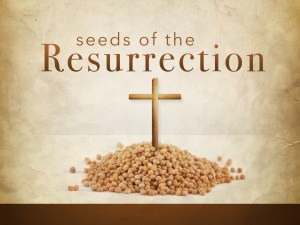
Seed of Promise

With Resurrection Sunday only a few days away, I think the article “Seed of Promise” by Margaret Manning helps put the necessity of Christ’s death in perspective.

Ms. Manning writes:

“Unless a grain of wheat falls into the earth and dies, it remains by itself, alone; but if it dies, it bears much fruit.”(1) 

His hour had come. He had walked among them, taught them, performed miraculous signs, and he had loved and cared for them. But now, his hour had come and the cross lay ahead of him. The “hour” he faced would be filled with trial and suffering: “Now, my soul has become troubled and what shall I say, ‘Father, save me from this hour?'” 

Jesus would walk the long, lonely road to the cross. Rather than taking the way of self-preservation, he would offer his life, like a grain of wheat. He would die; he would be buried in the darkness of the earth, but as a result he would bear much fruit. Despite what lay ahead of him, and despite the trouble in his soul, he affirms, “For this purpose I came to this hour. Father, glorify your name.” 

Of what was transacted there on that cross, there are many theories.(2) In formal theology, these “theories” attempt to get at the very nature and the very essence of what Jesus accomplished through his death. For theologians, atonement studies are a fertile field of inquiry because the meaning and impact of the atonement are rich, complex, and paradoxical. One theory, for example, suggests that the atonement stands as the preeminent example of a sacrificial life. Other theories argue that the cross is the ultimate symbol of divine love, or that the cross demonstrates God’s divine justice against sin as the violation of his perfect law. Still other theories suggest the cross overcame the forces of sin and evil, restored God’s honor in relation to God’s holiness and righteousness, or served as a substitution for the death we all deserved because of sin. 

While the nature of the atonement may include a portion of all of these theories, Jesus’s statements as recorded in John’s gospel indicate that his death would be a path to abundant life resulting in the production of much fruit. And in this case, Jesus doesn’t construct a theory of the atonement, but instead chooses an agrarian image to indicate what would be accomplished in the cross. “The hour has come for the Son of Man to be glorified… unless a grain of wheat falls into the earth and dies, it remains by itself alone, but if it dies, it bears much fruit” (John 12:23-24). Charles Spurgeon, the nineteenth century theologian and preacher, wrote that this passage of Scripture is rich with paradoxical statements describing the nature of atonement: 

“[P]aradox is this—that his glory was to come to him through shame…[that] the greatest fulness of our Lord’s glory arises out of his emptying himself, and becoming obedient to death, even the death of the cross. It is his highest reputation that he made himself of no reputation. His crown derives new luster from his cross….We must never forget this, and if ever we are tempted to merge the crucified Saviour in the coming King we should feel rebuked by the fact that thus we should rob our Lord of his highest honour.”(3) 

Spurgeon expands on the paradoxical nature of death-bringing forth life. It is only through the cross, just as a kernel of wheat must die in order to produce a harvest, that new life in Christ and reconciliation with God are accomplished. Most powerfully, Spurgeon notes that “this teaches us where the vital point of Christianity lies, Christ’s death is the life of his teaching. See here: if Christ’s preaching had been the essential point, or if his example had been the vital point, he could have brought forth fruit and multiplied Christians by his preaching, and by his example. But he declares that, except he shall die, he shall not bring forth fruit.”(4) 

We see this paradox borne out every spring. Dead bulbs ugly, brown, and buried in dark soil all winter burst from their earthen tomb green with life and bright with color. Their glory disguised in ugly packaging, and one bulb producing green leaves and flowers in abundance. So it is with Jesus’s passion and death: glory and abundance come out of sorrow, shame, death and suffering. Encased in the cross of Golgotha is a beautiful, life-giving seed. 

Long before the beauty of Easter morning, a tiny kernel of wheat dies; it lays buried seemingly dead underground. This is a great paradox, but one in which we can come to glory, one in which we can find our lives. 

See from his head, his hands, his feet Sorrow and love flow mingled down Did ere such love and sorrow meet Or thorns compose so rich a crown?(5) 

Margaret Manning is a member of the writing and speaking team at Ravi Zacharias International Ministries in Seattle, Washington.  

(1) John 12:24. (2) The following theories of the atonement are based upon Millard Erickson’s Christian Theology (Grand Rapids: Baker Books, 1983), 781-823. (3) “The Corn of Wheat Dying to Bring Forth Fruit: John 12:23-25,” Charles H. Spurgeon, Farm Sermons (c 1875), from http://textweek.com, accessed April 2, 2009. (4) Ibid. (5) “When I Survey the Wondrous Cross,” written by Isaac Watts, 1707.


The Hope of Parents for Their Children

As a parent my greatest desire is to see my son grow up loving, honoring, and serving the Lord. We read the Bible and pray together almost every night. We take him to church a couple of times a week. We try to explain to him that the way we treat others is a direct reflection of our relationship with God. We want him to understand the difference between cultural morality and living out the Christian life. We want to teach him that his life is to be lived as a demonstration of his love for God.

We are prayerfully seeking God’s wisdom to raise our son up in the ways of the Lord; however, there is no guarantee he will obey or continue in these teachings. As a pastor I have seen too many parents broken because of the choices of their children. They were godly parents and yet somewhere along the way their children departed from the godly path.

Because of this, parents often ask me about Proverbs 22:6 “Train up a child in the way he should go; even when he is old he will not depart from it.” They feel like they held up their end by raising the child the right way,  but now that same son or daughter wants nothing to do with God, Jesus, or the church. These parents just want to know what they did wrong or if there is anything they can do to fix the situation.

This morning I found a few insightful thoughts on D.A. Carson’s blog in regard to this verse. Dr. Carson writes: “The proverb ‘Train a child in the way he should go, and when he is old he will not turn from it’ (Prov. 22:6) is so well known that it cries out for comment. Recall that a proverb is neither case law nor unqualified promise (review meditation for March 23). When children go wrong, very often the careful observer can spot familial reasons that have contributed to the rebellion. But this is not always the case. Sometimes young people from evidently wonderful families kick the traces. Some return years later; some never do. Good families may produce prodigal sons. This proverb must not be treated as if it were a promise that fails periodically. Rather, it is a proverb: it tells how God has structured reality, and what we should do to conform to it. This is the principle of how families work; it includes no footnotes and mentions no exceptions.”

As parents we are going to make mistakes in raising our children. However, if we strive to honor God in the raising of our kids, if we set the Word, the commands, and ways of God before them, and if we try to be a living example of all we teach then we can rest knowing that we did our best. There comes a time when our kids must choose which path they will take. Yes it is heartbreaking when they make terrible choices, but as their parents we will still have opportunities to use our authority to influence them in the right direction. But in the end they must choose which path of life to follow.

Regardless of the age of our kids, there are few ways we can continue to train them up in the ways of the Lord. First, pray for them. Pray for their wisdom, holiness, and even conviction of sin. We can also lovingly and gently offer advice. If they are receptive, sit down with them and share your concerns. And finally, love them. My past is littered with mistakes the I believe greatly disappointed my parents; however, I always knew they loved me. It was their reflecting the unconditional love of God that helped lead me to repentance and a godly Christ-like life.

So parents do your part in putting children on the right course. Then entrust them into the hands of God knowing that He will never give up on drawing them to Himself.

The Needle Was this Big!

As a boy growing up I remember having to go to the health department to get my shots in order to start school. I do not have any idea what they were for, but I most definitely remember the atmosphere.

You would sign in and then sit in a waiting area for your name to be called. In the waiting area there were a lot of kids doing one of two things—begging mom in tears, “Don’t make me get a shot. I’ll be good. Don’t let them stick me mommy!” or they were, what I like to call, scream-crying. I would explain the last one to you, but I am certain just thinking about a child scream-crying will cause you to take two aspirin.

Here I am, a little kid and all, watching other kids being tortured with the thought of getting a shot or in hysterics from being viciously attacked with a giant needle. My anxiety level was rapidly climbing the charts, mostly because I was imagining a shot about the size of the Seattle Space Needle. As the minutes ticked away I began to fantasize of what was about to happen. I could imagine several nurses holding me down while the doctor put the ever-growing needle into my arm. The longer I had to wait with the many other kids crying hysterically only heightened my sense of dread.

Realizing there was no way I could go through with this, I began to plan out my speech to my mother. I had made a list of all the chores I could do if only we would leave right now. But before I could get the words out it happened—“Bobby Pittenger, could you please come back to see the doctor?”

What happened next was like a blur. There was only one doctor and his nurse with me. No one was there to help hold me down. The initial stick of the needle hurt a little, but within seconds the pain and the bleeding stopped. It seemed as if it had only taken five minutes, but that could not possibly be true, could it? I remember thinking, “Is that it?” All the anxiety, crying, screaming, begging, and pleading for a little stick in the arm? Clearly the anxiety of wondering what was going to happen was far greater than the actual event. And if the truth were told, the torture I expected to endure was all in my head. I guess an anxious heart can be very, very deceptive.

How often does an anxious heart deceive us in regard to life’s difficulties? Philippians 4.6-7 says, “Be anxious for nothing, but in everything by prayer and supplication, with thanksgiving, let your requests be made known to God; and the peace of God, which surpasses all understanding, will guard your hearts and minds through Christ Jesus.” Be anxious for nothing. Don’t let bills, health, work, money, or anything else cause anxiety in your life. God doesn’t give us a loop-hole for a little bit of anxiety? Nope, He says, “Don’t be anxious.”

Fortunately, God doesn’t leave us hanging with just a “Thou Shalt Not Command.” Notice His plan to avoid anxiety:

  1. Prayer—spend time talking with God each day.
  2. Supplication—seek Him, share your concerns.
  3. With thanksgiving—tell Him how thankful you are for His presence, provision, protection, and promises during you difficulties.
  4. Share your requests—be honest about your needs, wants, and wishes.

Obeying God’s plan for defeating anxiety guarantees “the peace of God, which surpasses all understanding, will guard your hearts and minds through Christ Jesus.”

Questions for Group Discussion

I. Paul promised the peace of God would guard our hearts and minds when we cast our cares upon Him.  There are times when we move our focus from God toward the problem. You may not be immediately overcome by anxiety, however, like quicksand, the more you struggle the faster you sink. With that in mind:

  1. What is something that has caused great anxiety in your life?
  2. Where did the anxiety take you (fear, worry, fretting, anger, blaming, doubt)?
  3. How would things have been different if you had kept your focus on God and allowed Him to guard your heart and mind?

II. God has said that all of creation is good (see Genesis 1-2). We know that He created these things for our enjoyment, which brings Him glory. So…

  1. What are some of the ways you find comfort during stressful or difficult times? (e.g. family time, food, company, TV, shopping, etc.)
  2. How do these point you toward God?
  3. How do you ensure that these things are from God and not just your efforts to mask the fear and anxiety?

III. After being unjustly beaten, Paul and Silas were able to demonstrate the peace that surpasses all understanding while imprisoned in Philippi. Jesus lived out this peace throughout His journey to the cross. So…

  1. How did He remain in peace even when the wrath of God was about to be poured out upon Him?
  2. Remembering that Jesus is a human just like you, how can you have peace even when the world seems to be crumbling down around you?

Palm Sunday!

They brought [the colt] to Jesus, and they threw their coats on the colt and put Jesus on it. 36 As He was going, they were spreading their coats on the road. 37 As soon as He was approaching, near the descent of the Mount of Olives, the whole crowd of the disciples began to praise God joyfully with a loud voice for all the miracles which they had seen, 38 shouting:

“BLESSED IS THE KING WHO COMES IN THE NAME OF THE LORD;
Peace in heaven and glory in the highest!”

39 Some of the Pharisees in the crowd said to Him, “Teacher, rebuke Your disciples.” 40 But Jesus answered, “I tell you, if these become silent, the stones will cry out!”

The Red Umbrella

As the drought continued for what seemed an eternity, a small community of midwest farmers were in a quandary as to what to do. The rain was important not only in order to keep the crops healthy, but to sustain the townspeople’s very way of living. As the problem became more urgent, the local church felt it was time to get involved and planned a prayer meeting in order to ask for rain.

In what seemed a vague remembrance of an old Native American ritual, the people began to show. The pastor soon arrived and watched as his congregation continued to file in. He slowly circulated from group to group as he made his way to the front in order to officially begin the meeting. Everyone he encountered was visiting across the aisles, enjoying the chance to socialize with their close friends. As the pastor finally secured his place in front of his flock, his thoughts were on the importance of quieting the crowd and starting the meeting.

Just as he began asking for quiet, he noticed an eleven-year-old girl sitting in the front row. She was angelically beaming with excitement and laying next to her was her bright red umbrella, poised for use. The beauty and innocence of this sight made the pastor smile to himself as he realized the faith this young girl possessed that the rest of the people in the room seemed to have forgotten. For the rest had come just to pray for rain…she had come to see God’s answer.