
 I first began to pray for my children in 1980 at the age of sixteen. At first I wasn’t sure what to pray, but over time my prayers became progressively more focused; especially after my son was born. Thirty-two years later I can clearly see the abundant return of all those hours spent on my knees praying for him. I am still praying today that God will continue working in him until he attains “to the unity of the faith and of the knowledge of the Son of God, to mature manhood, to the measure of the stature of the fullness of Christ” (Eph. 4.13).
I would encourage you today to begin praying for your children, even if you are years away from starting a family. Here is a post by Jon Bloom that will assist you in beginning to pray for your children. Please remember, your prayers are most effective when they are an overflow of your lifestyle. The greatest witness to your children is you, so live out your prayers for them to see and follow.
Bloom writes:
So, here are seven helpful, specific things to pray for your children:
1. That Jesus will call them and no one will hinder them from coming.
Then children were brought to him that he might lay his hands on them and pray. The disciples rebuked the people, but Jesus said, “Let the little children come to me and do not hinder them, for to such belongs the kingdom of heaven.” And he laid his hands on them and went away. (Matthew 19:13–15)
2. That they will respond in faith to Jesus’s faithful, persistent call.
The Lord is not slow to fulfill his promise as some count slowness, but is patient toward you, not wishing that any should perish, but that all should reach repentance. (2 Peter 3:9)
3. That they will experience sanctification through the transforming work of the Holy Spirit and will increasingly desire to fulfill the greatest commandments.
And he said to him, “You shall love the Lord your God with all your heart and with all your soul and with all your mind. This is the great and first commandment. And a second is like it: You shall love your neighbor as yourself.” (Matthew 22:37-39)
4. That they will not be unequally yoked in intimate relationships, especially marriage.
Do not be unequally yoked with unbelievers. For what partnership has righteousness with lawlessness? Or what fellowship has light with darkness? (2 Corinthians 6:14)
5. That their thoughts will be pure.
Finally, brothers, whatever is true, whatever is honorable, whatever is just, whatever is pure, whatever is lovely, whatever is commendable, if there is any excellence, if there is anything worthy of praise, think about these things. (Philippians 4:8)
6. That their hearts will be stirred to give generously to the Lord’s work.
All the men and women, the people of Israel, whose heart moved them to bring anything for the work that the Lord had commanded by Moses to be done brought it as a freewill offering to the Lord. (Exodus 35:29)
7. That when the time is right, they will GO!
And Jesus came and said to them, “All authority in heaven and on earth has been given to me. Go therefore and make disciples of all nations, baptizing them in the name of the Father and of the Son and of the Holy Spirit, teaching them to observe all that I have commanded you. And behold, I am with you always, to the end of the age.” (Matthew 28:18-20)
 I can still remember the day my son was born. I had been praying for him for twenty-four years and now he was finally here! The nurse had just finished wrapping him up when she said, “Mr. Pittenger, would you like to hold your son?” I nodded my head yes with tears of joy streaming down my face. The joy I felt that day was more than I could ever have thought or imagined.
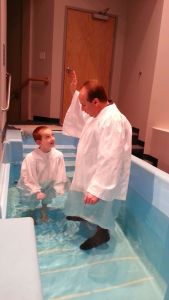 because it was the same day I was baptized in 1974. I had started praying for his salvation way back in 1980 when I was 16, and now at the age of 48 I was seeing the fruit of all those prayers. I baptized him and as he came up out of the water once again my eyes were filled with tears of joy—uncontrollable JOY!
 As I left church today I was overcome with tears of joy from seeing so many people join the family of God. I don’t know any of their names, where they live, or what they do for a living, but I do know they are my family—my eternal family!

 In
In 
 Bob Pittenger