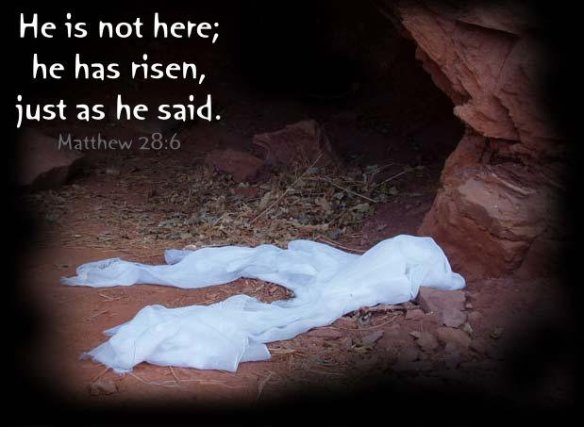
 Easter is a time when we celebrate the suffering, death, and resurrection of Jesus Christ. It is easy for us to focus on Christ’s suffering and death upon the cross; however, without the resurrection we have no hope for the forgiveness of sin or eternal life with God. Matthew Barrett shares with us what is gained through Christ’s resurrection in his article “The Neglected Resurrection.”
Barrett writes:
Too often in our churches the resurrection of Christ is a doctrine of secondary importance. It is neglected and forgotten until Easter comes around each year. The same disregard for the resurrection is seen in how we share the gospel. Christians tend to share the gospel as if Jesus died on the cross and that is the end of the story. We make a zip line from the crucifixion to “repent and believe,” contrary to the example Peter sets for us in Acts 2:22-24 and 4:26. The cross is central to our salvation, but what God accomplished there is incomplete unless the tomb is empty on Sunday morning. Therefore, the resurrection of Christ is vital “for us and our salvation” (to borrow from the Nicene Creed). But how exactly?
Our Regeneration Is Grounded in the Resurrection of Christ
Have you ever read the resurrection narratives and said, “Praise God! Because Christ has risen I am born again!” I know I haven’t. But if we truly understand the implications of Christ’s resurrection for our salvation, the new birth would be the first place to turn. Scripture teaches that our new birth—God’s supernatural, monergistic act whereby the Spirit makes us a new creature in Christ, replacing our heart of stone with a heart of flesh—is only possible because Jesus is risen.
Consider two passages. According to Peter, God has “caused us to be born again to a living hope through the resurrection of Jesus Christ from the dead” (1 Pet 1:3). The same God who raised Christ from the grave has also raised us from spiritual death to spiritual life. And the apostle Paul says that while we were dead in our trespasses and sins, God, being rich in mercy, “made us alive together with Christ” and “raised us up with him and seated us with him in the heavenly places in Christ Jesus” (Eph 2:5-6; cf. Col 3:1).
Because God has raised Christ from the dead, he can make us alive together with Christ by the power of the Holy Spirit. Christ’s resurrection life is the very basis and means by which we are born again.
Our Justification Is Grounded in the Resurrection of Christ
Those who believe in the God who raised Christ from the dead are counted righteous. As Paul says in Romans 4:23-25, like Abraham we are counted righteous, for we believe in him “who raised from the dead Jesus our Lord, who was delivered up for our trespasses and raised for our justification.” By raising Jesus from the dead, God approved the work of Christ on the cross for our sins. God declared his Son’s work complete! The penalty for our sin has been paid, and no guilt remains. As Wayne Grudem explains:
When the Father in essence said to Christ, “All the penalty for sins has been paid and I find you not guilty but righteous in my sight,” he was thereby making the declaration that would also apply to us once we trusted in Christ for salvation. In this way Christ’s resurrection also gave final proof that he had earned our justification (Systematic Theology).
Jonathan Edwards also states the matter precisely:
For if Christ were not risen, it would be evidence that God was not yet satisfied for [our] sins. Now the resurrection is God declaring his satisfaction; he thereby declared that it was enough; Christ was thereby released from his work; Christ, as he was Mediator, is thereby justified (Miscellanies, Vol. 13, 227).
In other words, if God did not raise Christ from the dead, he would essentially be saying, “I am not satisfied with your atoning work on behalf of sinners.” If this were the case, we would still be dead in our sins, as Paul says in 1 Corinthians 15:17. And if we are still dead in our sins then we stand guilty before a holy God, unjustified and condemned. It is hard to improve upon the words of Martyn Lloyd-Jones:
If it is not a fact that Christ literally rose from the grave, then you are still guilty before God. Your punishment has not been borne, yours sins have not been dealt with, you are yet in your sins. It matters that much: without the Resurrection you have no standing at all (The Assurance of Our Salvation, 492).
Our Sanctification Is Grounded in the Resurrection of Christ
In Romans 6, Paul explains that we can “walk in newness of life” because Christ was raised from the dead. We are not to continue in sin, for how, as Paul asked, “can we who died to sin still live in it?” We have been baptized into the death of Christ so that “just as Christ was raised from the dead by the glory of the Father, we too might walk in newness of life” (Rom 6:3-4). But Paul is not finished. He has much more to say about the resurrection and our sanctification.
For if we have been united with him in a death like his, we shall certainly be united with him in a resurrection like his. We know that our old self was crucified with him in order that the body of sin might be brought to nothing, so that we would no longer be enslaved to sin. For one who has died has been set free from sin. Now if we have died with Christ, we believe that we will also live with him. We know that Christ, being raised from the dead, will never die again; death no longer has dominion over him. For the death he died he died to sin, once for all, but the life he lives he lives to God. So you also must consider yourselves dead to sin and alive to God in Christ Jesus (Rom 6:5-12).
Paul’s last two sentences are especially powerful. As Christians, we are united to Christ. Christ died to sin, and so also must we consider ourselves dead to sin. But Christ also came back to life. The life he lives he lives to God. Therefore, as those who are in Christ, we are alive to God. No longer are we to walk according to the flesh, but according to the Spirit. Our old, unbelieving, sinful, condemned self has been crucified with Christ. And now that we are new creatures, we are no longer enslaved to sin, but by the power of the Spirit are able to walk in this newness of life.
None of this, however, is possible if Christ remains in the tomb. His resurrection is our victory over the reign of sin. Only because he has risen do we have the assurance, the confidence, and the ability to now walk in godliness. In this light, therefore, Paul’s admonition is all the more convicting:
If then you have been raised with Christ, seek the things that are above, where Christ is, seated at the right hand of God. Set your minds on things that are above, not on things that are on earth. For you have died, and your life is hidden with Christ in God. When Christ who is your life appears, then you also will appear with him in glory (Col 3:1-4).
The Climax of Redemptive History
Richard Gaffin once wrote that not only is the resurrection of Christ the pivotal factor in Paul’s soteriology, the “climax of the redemptive history of Christ,” but it is also that “from which the individual believer’s experience of redemption derives in its specific and distinguishing character and in all aspects of its inexhaustible fullness” (Resurrection and Redemption, 135).
I couldn’t agree more. If we miss the importance of Christ’s resurrection for our salvation, then we have, as Sinclair Ferguson observes, misunderstood the gospel, severing our salvation from the lordship of Christ (Resurrection and Redemption, 6). How unthinkable this must be for the Christian who, as Calvin explains, believes that “our whole salvation and all its parts are comprehended in Christ” (Institutes II.16.19).